Teknik lanjutan untuk QAOA
Perkiraan penggunaan: 3 menit pada prosesor Heron r2 (CATATAN: Ini hanya perkiraan. Waktu aktual bisa berbeda.)
Prasyarat
-
Dasar-dasar Quantum Approximate Optimization Algorithm (QAOA)
-
Pelajaran Utility-scale QAOA (bagian dari kursus Quantum computing in practice) di IBM Quantum® Learning
Hasil belajar
- Menggunakan teknik-teknik lanjutan yang membantu meningkatkan transpilasi QAOA dan memberikan cara untuk meningkatkan performa QAOA
Untuk panduan detail tentang isi tutorial ini, lihat video Qiskit ini.
Latar Belakang
Tutorial ini memperkenalkan dua teknik lanjutan untuk meningkatkan performa Quantum Approximate Optimization Algorithm (QAOA) pada jumlah qubit yang besar.
Teknik-teknik lanjutan dalam notebook ini meliputi:
-
Strategi SWAP dengan pemetaan awal SAT: Ini adalah transpiler pass yang dirancang khusus untuk QAOA yang menggunakan strategi SWAP dan SAT solver secara bersamaan untuk memperbaiki pemilihan qubit fisik mana pada QPU yang akan digunakan. Strategi SWAP memanfaatkan sifat komutativitas operator QAOA untuk mengatur ulang gate agar lapisan gate SWAP dapat dieksekusi secara bersamaan, sehingga mengurangi kedalaman Circuit [1]. SAT solver digunakan untuk menemukan pemetaan awal yang meminimalkan jumlah operasi SWAP yang diperlukan untuk memetakan qubit dalam Circuit ke qubit fisik pada perangkat [2].
-
Fungsi biaya CVaR: Biasanya nilai ekspektasi dari Hamiltonian biaya digunakan sebagai fungsi biaya untuk QAOA, tetapi seperti yang ditunjukkan dalam [3], berfokus pada ekor distribusi, bukan nilai ekspektasi, dapat meningkatkan performa QAOA untuk masalah optimasi kombinatorial. CVaR mencapai ini. Untuk sekumpulan shots dengan nilai objektif yang sesuai dari masalah optimasi yang dipertimbangkan, Conditional Value at Risk (CVaR) dengan tingkat kepercayaan didefinisikan sebagai rata-rata dari shots terbaik [3]. Dengan demikian, sesuai dengan nilai ekspektasi standar, sedangkan sesuai dengan minimum dari shots yang diberikan, dan merupakan pertukaran antara berfokus pada shots yang lebih baik, sambil tetap melakukan sedikit perataan untuk memuluskan lanskap optimasi. Selain itu, CVaR dapat digunakan sebagai teknik mitigasi kesalahan untuk meningkatkan kualitas estimasi nilai objektif [4].
Pada akhir tutorial ini, kamu seharusnya dapat menggunakan teknik-teknik ini untuk mendapatkan hasil terbaik dari menjalankan QAOA untuk masalah optimasimu.
Persyaratan
Sebelum memulai tutorial ini, pastikan kamu sudah menginstal hal-hal berikut:
-
Qiskit SDK v2.0 atau lebih baru, dengan dukungan visualisasi
-
Qiskit Runtime v0.43 atau lebih baru (
pip install qiskit-ibm-runtime) -
Pustaka graf Rustworkx (
pip install rustworkx) -
Python SAT (
pip install python-sat)
Pengaturan
# Added by doQumentation — required packages for this notebook
!pip install -q matplotlib numpy python-sat qiskit qiskit-ibm-runtime rustworkx scipy
from __future__ import annotations

import numpy as np
import rustworkx as rx
from dataclasses import dataclass
from itertools import combinations
from threading import Timer
from collections.abc import Callable, Iterable
from pysat.formula import CNF, IDPool
from pysat.solvers import Solver
from scipy.optimize import minimize
from rustworkx.visualization import mpl_draw as draw_graph

from qiskit.quantum_info import SparsePauliOp
from qiskit.circuit.library import QAOAAnsatz
from qiskit.circuit import QuantumCircuit, ParameterVector
from qiskit.transpiler import CouplingMap, PassManager
from qiskit.transpiler.preset_passmanagers import generate_preset_pass_manager
from qiskit.transpiler.passes.routing.commuting_2q_gate_routing import (
    SwapStrategy,
    FindCommutingPauliEvolutions,
    Commuting2qGateRouter,
)

from qiskit_ibm_runtime import QiskitRuntimeService, Session
from qiskit_ibm_runtime import SamplerV2 as Sampler
Masalah max-cut
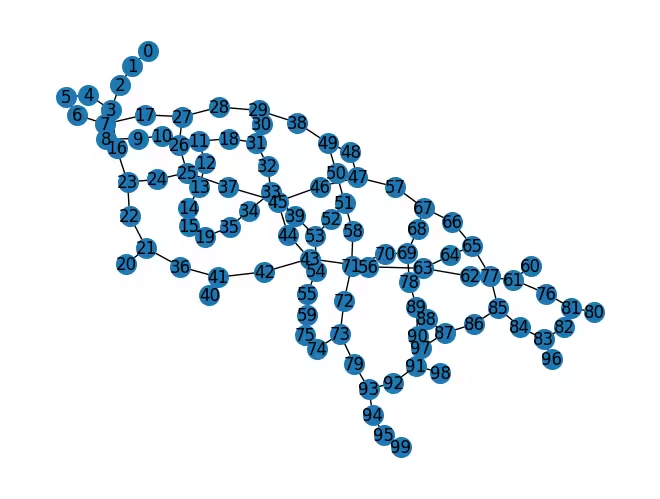
Mari kita coba menyelesaikan masalah max-cut pada graf dengan 100 node menggunakan QAOA. Masalah max-cut adalah masalah optimasi kombinatorial yang didefinisikan pada graf , di mana adalah himpunan simpul dan adalah himpunan sisi. Tujuannya adalah mempartisi simpul menjadi dua himpunan, dan , sedemikian sehingga jumlah sisi antara dua himpunan tersebut dimaksimalkan. Dalam contoh ini, kita menggunakan graf dengan 100 node yang didasarkan pada coupling map hardware.
Contoh simulator skala kecil
Karena tujuan tutorial ini adalah menunjukkan bagaimana performa QAOA pada skala yang melampaui kemampuan simulator, kita tidak akan membahas langkah ini.
Jika kamu ingin mencoba alur kerja QAOA berbasis simulator, coba tutorial Quantum approximate optimization algorithm.
Contoh hardware skala besar
Langkah 1: Petakan input klasik ke masalah kuantum
Graf → Hamiltonian
Pertama, petakan masalah ke Circuit kuantum yang sesuai untuk QAOA. Detail proses ini dapat ditemukan di tutorial QAOA pengantar.
# Instantiate runtime to access backend
service = QiskitRuntimeService()
backend = service.least_busy(
    min_num_qubits=100, operational=True, simulator=False
)
print(backend)
<IBMBackend('ibm_fez')>
# Check if the coupling map is symmetric. We will add a conditional below
# to avoid over-counting edges for symmetric/bi-directional coupling maps.

backend.coupling_map.is_symmetric
True
n = 100
graph_100 = rx.PyGraph()
graph_100.add_nodes_from((np.arange(0, n, 1)))
w = 1.0
elist = []

for edge in backend.coupling_map:
    if (edge[0] < n) and (edge[1] < n):
        # Conditional to avoid over-counting edges
        if (
            edge[1],
            edge[0],
            w,
        ) not in elist:
            elist.append((edge[0], edge[1], w))

graph_100.add_edges_from(elist)
draw_graph(graph_100, with_labels=True)

# Construct cost hamiltonian

def build_max_cut_paulis(graph: rx.PyGraph) -> list[tuple[str, float]]:
    """Convert the graph to Pauli list.

    This function does the inverse of `build_max_cut_graph`
    """
    pauli_list = []
    for edge in list(graph.edge_list()):
        paulis = ["I"] * len(graph)
        paulis[edge[0]], paulis[edge[1]] = "Z", "Z"

        weight = graph.get_edge_data(edge[0], edge[1])

        pauli_list.append(("".join(paulis)[::-1], weight))

    return pauli_list

max_cut_paulis = build_max_cut_paulis(graph_100)

cost_hamiltonian = SparsePauliOp.from_list(max_cut_paulis)
print("Cost Function Hamiltonian:", cost_hamiltonian)
Cost Function Hamiltonian: SparsePauliOp(['IIIIIIIIIIIIIIIIIIIIIIIIIIIIIIIIIIIIIIIIIIIIIIIIIIIIIIIIIIIIIIIIIIIIIIIIIIIIIIIIIIIIIIIIIIIIIIIIIIZZ', 'IIIIIIIIIIIIIIIIIIIIIIIIIIIIIIIIIIIIIIIIIIIIIIIIIIIIIIIIIIIIIIIIIIIIIIIIIIIIIIIIIIIIIIIIIIIIIIIIIZZI', 'IIIIIIIIIIIIIIIIIIIIIIIIIIIIIIIIIIIIIIIIIIIIIIIIIIIIIIIIIIIIIIIIIIIIIIIIIIIIIIIIIIIIIIIIIIIIIIIIZZII', 'IIIIIIIIIIIIIIIIIIIIIIIIIIIIIIIIIIIIIIIIIIIIIIIIIIIIIIIIIIIIIIIIIIIIIIIIIIIIIIIIIIIIIIIIIIIIIIIZZIII', 'IIIIIIIIIIIIIIIIIIIIIIIIIIIIIIIIIIIIIIIIIIIIIIIIIIIIIIIIIIIIIIIIIIIIIIIIIIIIIIIIIIIZIIIIIIIIIIIIZIII', 'IIIIIIIIIIIIIIIIIIIIIIIIIIIIIIIIIIIIIIIIIIIIIIIIIIIIIIIIIIIIIIIIIIIIIIIIIIIIIIIIIIIIIIIIIIIIIIZZIIII', 'IIIIIIIIIIIIIIIIIIIIIIIIIIIIIIIIIIIIIIIIIIIIIIIIIIIIIIIIIIIIIIIIIIIIIIIIIIIIIIIIIIIIIIIIIIIIIZZIIIII', 'IIIIIIIIIIIIIIIIIIIIIIIIIIIIIIIIIIIIIIIIIIIIIIIIIIIIIIIIIIIIIIIIIIIIIIIIIIIIIIIIIIIIIIIIIIIIZZIIIIII', 'IIIIIIIIIIIIIIIIIIIIIIIIIIIIIIIIIIIIIIIIIIIIIIIIIIIIIIIIIIIIIIIIIIIIIIIIIIIIIIIIIIIIIIIIIIIZZIIIIIII', 'IIIIIIIIIIIIIIIIIIIIIIIIIIIIIIIIIIIIIIIIIIIIIIIIIIIIIIIIIIIIIIIIIIIIIIIIIIIIIIIIIIZIIIIIIIIIZIIIIIII', 'IIIIIIIIIIIIIIIIIIIIIIIIIIIIIIIIIIIIIIIIIIIIIIIIIIIIIIIIIIIIIIIIIIIIIIIIIIIIIIIIIIIIIIIIIIZZIIIIIIII', 'IIIIIIIIIIIIIIIIIIIIIIIIIIIIIIIIIIIIIIIIIIIIIIIIIIIIIIIIIIIIIIIIIIIIIIIIIIIIIIIIIIIIIIIIIZZIIIIIIIII', 'IIIIIIIIIIIIIIIIIIIIIIIIIIIIIIIIIIIIIIIIIIIIIIIIIIIIIIIIIIIIIIIIIIIIIIIIIIIIIIIIIIIIIIIIZZIIIIIIIIII', 'IIIIIIIIIIIIIIIIIIIIIIIIIIIIIIIIIIIIIIIIIIIIIIIIIIIIIIIIIIIIIIIIIIIIIIIIIIIIIIIIIIIIIIIZZIIIIIIIIIII', 'IIIIIIIIIIIIIIIIIIIIIIIIIIIIIIIIIIIIIIIIIIIIIIIIIIIIIIIIIIIIIIIIIIIIIIIIIIIIIIIIIZIIIIIIZIIIIIIIIIII', 'IIIIIIIIIIIIIIIIIIIIIIIIIIIIIIIIIIIIIIIIIIIIIIIIIIIIIIIIIIIIIIIIIIIIIIIIIIIIIIIIIIIIIIZZIIIIIIIIIIII', 'IIIIIIIIIIIIIIIIIIIIIIIIIIIIIIIIIIIIIIIIIIIIIIIIIIIIIIIIIIIIIIIIIIIIIIIIIIIIIIIIIIIIIZZIIIIIIIIIIIII', 'IIIIIIIIIIIIIIIIIIIIIIIIIIIIIIIIIIIIIIIIIIIIIIIIIIIIIIIIIIIIIIIIIIIIIIIIIIIIIIIIIIIIZZIIIIIIIIIIIIII', 'IIIIIIIIIIIIIIIIIIIIIIIIIIIIIIIIIIIIIIIIIIIIIIIIIIIIIIIIIIIIIIIIIIIIIIIIIIIIIIIIZIIIZIIIIIIIIIIIIIII', 'IIIIIIIIIIIIIIIIIIIIIIIIIIIIIIIIIIIIIIIIIIIIIIIIIIIIIIIIIIIIIIIIIIIIIIIIIIIIZIIIIIIZIIIIIIIIIIIIIIII', 'IIIIIIIIIIIIIIIIIIIIIIIIIIIIIIIIIIIIIIIIIIIIIIIIIIIIIIIIIIIIIIIIIIIIIIIIZIIIIIIIIIZIIIIIIIIIIIIIIIII', 'IIIIIIIIIIIIIIIIIIIIIIIIIIIIIIIIIIIIIIIIIIIIIIIIIIIIIIIIIIIIIIIIIIIIZIIIIIIIIIIIIZIIIIIIIIIIIIIIIIII', 'IIIIIIIIIIIIIIIIIIIIIIIIIIIIIIIIIIIIIIIIIIIIIIIIIIIIIIIIIIIIIIIIZIIIIIIIIIIIIIIIZIIIIIIIIIIIIIIIIIII', 'IIIIIIIIIIIIIIIIIIIIIIIIIIIIIIIIIIIIIIIIIIIIIIIIIIIIIIIIIIIIIIIIIIIIIIIIIIIIIIZZIIIIIIIIIIIIIIIIIIII', 'IIIIIIIIIIIIIIIIIIIIIIIIIIIIIIIIIIIIIIIIIIIIIIIIIIIIIIIIIIIIIIIIIIIIIIIIIIIIIZZIIIIIIIIIIIIIIIIIIIII', 'IIIIIIIIIIIIIIIIIIIIIIIIIIIIIIIIIIIIIIIIIIIIIIIIIIIIIIIIIIIIIIIZIIIIIIIIIIIIIIZIIIIIIIIIIIIIIIIIIIII', 'IIIIIIIIIIIIIIIIIIIIIIIIIIIIIIIIIIIIIIIIIIIIIIIIIIIIIIIIIIIIIIIIIIIIIIIIIIIIZZIIIIIIIIIIIIIIIIIIIIII', 'IIIIIIIIIIIIIIIIIIIIIIIIIIIIIIIIIIIIIIIIIIIIIIIIIIIIIIIIIIIIIIIIIIIIIIIIIIIZZIIIIIIIIIIIIIIIIIIIIIII', 'IIIIIIIIIIIIIIIIIIIIIIIIIIIIIIIIIIIIIIIIIIIIIIIIIIIIIIIIIIIIIIIIIIIIIIIIIIZZIIIIIIIIIIIIIIIIIIIIIIII', 'IIIIIIIIIIIIIIIIIIIIIIIIIIIIIIIIIIIIIIIIIIIIIIIIIIIIIIIIIIIIIIIIIIIIIIIIIZZIIIIIIIIIIIIIIIIIIIIIIIII', 'IIIIIIIIIIIIIIIIIIIIIIIIIIIIIIIIIIIIIIIIIIIIIIIIIIIIIIIIIIIIIIZIIIIIIIIIIIZIIIIIIIIIIIIIIIIIIIIIIIII', 'IIIIIIIIIIIIIIIIIIIIIIIIIIIIIIIIIIIIIIIIIIIIIIIIIIIIIIIIIIIIIIIIIIIIIIIIZZIIIIIIIIIIIIIIIIIIIIIIIIII', 'IIIIIIIIIIIIIIIIIIIIIIIIIIIIIIIIIIIIIIIIIIIIIIIIIIIIIIIIIIIIIIIIIIIIIIIZZIIIIIIIIIIIIIIIIIIIIIIIIIII', 'IIIIIIIIIIIIIIIIIIIIIIIIIIIIIIIIIIIIIIIIIIIIIIIIIIIIIIIIIIIIIIIIIIIIIIZZIIIIIIIIIIIIIIIIIIIIIIIIIIII', 'IIIIIIIIIIIIIIIIIIIIIIIIIIIIIIIIIIIIIIIIIIIIIIIIIIIIIIIIIIIIIIIIIIIIIZZIIIIIIIIIIIIIIIIIIIIIIIIIIIII', 'IIIIIIIIIIIIIIIIIIIIIIIIIIIIIIIIIIIIIIIIIIIIIIIIIIIIIIIIIIIIIZIIIIIIIIZIIIIIIIIIIIIIIIIIIIIIIIIIIIII', 'IIIIIIIIIIIIIIIIIIIIIIIIIIIIIIIIIIIIIIIIIIIIIIIIIIIIIIIIIIIIIIIIIIIIZZIIIIIIIIIIIIIIIIIIIIIIIIIIIIII', 'IIIIIIIIIIIIIIIIIIIIIIIIIIIIIIIIIIIIIIIIIIIIIIIIIIIIIIIIIIIIIIIIIIIZZIIIIIIIIIIIIIIIIIIIIIIIIIIIIIII', 'IIIIIIIIIIIIIIIIIIIIIIIIIIIIIIIIIIIIIIIIIIIIIIIIIIIIIIIIIIIIIIIIIIZZIIIIIIIIIIIIIIIIIIIIIIIIIIIIIIII', 'IIIIIIIIIIIIIIIIIIIIIIIIIIIIIIIIIIIIIIIIIIIIIIIIIIIIIIIIIIIIIIIIIZZIIIIIIIIIIIIIIIIIIIIIIIIIIIIIIIII', 'IIIIIIIIIIIIIIIIIIIIIIIIIIIIIIIIIIIIIIIIIIIIIIIIIIIIIIIIIIIIZIIIIIZIIIIIIIIIIIIIIIIIIIIIIIIIIIIIIIII', 'IIIIIIIIIIIIIIIIIIIIIIIIIIIIIIIIIIIIIIIIIIIIIIIIIIIIIIIIIIIIIIIIZZIIIIIIIIIIIIIIIIIIIIIIIIIIIIIIIIII', 'IIIIIIIIIIIIIIIIIIIIIIIIIIIIIIIIIIIIIIIIIIIIIIIIIIIIIIIIIIZIIIIZIIIIIIIIIIIIIIIIIIIIIIIIIIIIIIIIIIII', 'IIIIIIIIIIIIIIIIIIIIIIIIIIIIIIIIIIIIIIIIIIIIIIIIIIIIIIZIIIIIIIZIIIIIIIIIIIIIIIIIIIIIIIIIIIIIIIIIIIII', 'IIIIIIIIIIIIIIIIIIIIIIIIIIIIIIIIIIIIIIIIIIIIIIIIIIZIIIIIIIIIIZIIIIIIIIIIIIIIIIIIIIIIIIIIIIIIIIIIIIII', 'IIIIIIIIIIIIIIIIIIIIIIIIIIIIIIIIIIIIIIIIIIIIIIZIIIIIIIIIIIIIZIIIIIIIIIIIIIIIIIIIIIIIIIIIIIIIIIIIIIII', 'IIIIIIIIIIIIIIIIIIIIIIIIIIIIIIIIIIIIIIIIIIIIIIIIIIIIIIIIIIZZIIIIIIIIIIIIIIIIIIIIIIIIIIIIIIIIIIIIIIII', 'IIIIIIIIIIIIIIIIIIIIIIIIIIIIIIIIIIIIIIIIIIIIIIIIIIIIIIIIIZZIIIIIIIIIIIIIIIIIIIIIIIIIIIIIIIIIIIIIIIII', 'IIIIIIIIIIIIIIIIIIIIIIIIIIIIIIIIIIIIIIIIIIIIIIIIIIIIIIIIZZIIIIIIIIIIIIIIIIIIIIIIIIIIIIIIIIIIIIIIIIII', 'IIIIIIIIIIIIIIIIIIIIIIIIIIIIIIIIIIIIIIIIIIIIIIIIIIIIIIIZZIIIIIIIIIIIIIIIIIIIIIIIIIIIIIIIIIIIIIIIIIII', 'IIIIIIIIIIIIIIIIIIIIIIIIIIIIIIIIIIIIIIIIIIIZIIIIIIIIIIIIZIIIIIIIIIIIIIIIIIIIIIIIIIIIIIIIIIIIIIIIIIII', 'IIIIIIIIIIIIIIIIIIIIIIIIIIIIIIIIIIIIIIIIIIIIIIIIIIIIIIZZIIIIIIIIIIIIIIIIIIIIIIIIIIIIIIIIIIIIIIIIIIII', 'IIIIIIIIIIIIIIIIIIIIIIIIIIIIIIIIIIIIIIIIIIIIIIIIIIIIIZZIIIIIIIIIIIIIIIIIIIIIIIIIIIIIIIIIIIIIIIIIIIII', 'IIIIIIIIIIIIIIIIIIIIIIIIIIIIIIIIIIIIIIIIIIIIIIIIIIIIZZIIIIIIIIIIIIIIIIIIIIIIIIIIIIIIIIIIIIIIIIIIIIII', 'IIIIIIIIIIIIIIIIIIIIIIIIIIIIIIIIIIIIIIIIIIIIIIIIIIIZZIIIIIIIIIIIIIIIIIIIIIIIIIIIIIIIIIIIIIIIIIIIIIII', 'IIIIIIIIIIIIIIIIIIIIIIIIIIIIIIIIIIIIIIIIIIZIIIIIIIIIZIIIIIIIIIIIIIIIIIIIIIIIIIIIIIIIIIIIIIIIIIIIIIII', 'IIIIIIIIIIIIIIIIIIIIIIIIIIIIIIIIIIIIIIIIIIIIIIIIIIZZIIIIIIIIIIIIIIIIIIIIIIIIIIIIIIIIIIIIIIIIIIIIIIII', 'IIIIIIIIIIIIIIIIIIIIIIIIIIIIIIIIIIIIIIIIIIIIIIIIIZZIIIIIIIIIIIIIIIIIIIIIIIIIIIIIIIIIIIIIIIIIIIIIIIII', 'IIIIIIIIIIIIIIIIIIIIIIIIIIIIIIIIIIIIIIIIIIIIIIIIZZIIIIIIIIIIIIIIIIIIIIIIIIIIIIIIIIIIIIIIIIIIIIIIIIII', 'IIIIIIIIIIIIIIIIIIIIIIIIIIIIIIIIIIIIIIIIIIIIIIIZZIIIIIIIIIIIIIIIIIIIIIIIIIIIIIIIIIIIIIIIIIIIIIIIIIII', 'IIIIIIIIIIIIIIIIIIIIIIIIIIIIIIIIIIIIIIIIIZIIIIIIZIIIIIIIIIIIIIIIIIIIIIIIIIIIIIIIIIIIIIIIIIIIIIIIIIII', 'IIIIIIIIIIIIIIIIIIIIIIIIIIIIIIIIIIIIIIIIIIIIIIZZIIIIIIIIIIIIIIIIIIIIIIIIIIIIIIIIIIIIIIIIIIIIIIIIIIII', 'IIIIIIIIIIIIIIIIIIIIIIIIIIIIIIIIIIIIIIIIIIIIIZZIIIIIIIIIIIIIIIIIIIIIIIIIIIIIIIIIIIIIIIIIIIIIIIIIIIII', 'IIIIIIIIIIIIIIIIIIIIIIIIIIIIIIIIIIIIIIIIIIIIZZIIIIIIIIIIIIIIIIIIIIIIIIIIIIIIIIIIIIIIIIIIIIIIIIIIIIII', 'IIIIIIIIIIIIIIIIIIIIIIIIIIIIIIIIIIIIIIIIZIIIZIIIIIIIIIIIIIIIIIIIIIIIIIIIIIIIIIIIIIIIIIIIIIIIIIIIIIII', 'IIIIIIIIIIIIIIIIIIIIIIIIIIIIIIIIIIIIZIIIIIIZIIIIIIIIIIIIIIIIIIIIIIIIIIIIIIIIIIIIIIIIIIIIIIIIIIIIIIII', 'IIIIIIIIIIIIIIIIIIIIIIIIIIIIIIIIZIIIIIIIIIZIIIIIIIIIIIIIIIIIIIIIIIIIIIIIIIIIIIIIIIIIIIIIIIIIIIIIIIII', 'IIIIIIIIIIIIIIIIIIIIIIIIIIIIZIIIIIIIIIIIIZIIIIIIIIIIIIIIIIIIIIIIIIIIIIIIIIIIIIIIIIIIIIIIIIIIIIIIIIII', 'IIIIIIIIIIIIIIIIIIIIIIIIZIIIIIIIIIIIIIIIZIIIIIIIIIIIIIIIIIIIIIIIIIIIIIIIIIIIIIIIIIIIIIIIIIIIIIIIIIII', 'IIIIIIIIIIIIIIIIIIIIIIIIIIIIIIIIIIIIIIZZIIIIIIIIIIIIIIIIIIIIIIIIIIIIIIIIIIIIIIIIIIIIIIIIIIIIIIIIIIII', 'IIIIIIIIIIIIIIIIIIIIIIIIIIIIIIIIIIIIIZZIIIIIIIIIIIIIIIIIIIIIIIIIIIIIIIIIIIIIIIIIIIIIIIIIIIIIIIIIIIII', 'IIIIIIIIIIIIIIIIIIIIIIIZIIIIIIIIIIIIIIZIIIIIIIIIIIIIIIIIIIIIIIIIIIIIIIIIIIIIIIIIIIIIIIIIIIIIIIIIIIII', 'IIIIIIIIIIIIIIIIIIIIIIIIIIIIIIIIIIIIZZIIIIIIIIIIIIIIIIIIIIIIIIIIIIIIIIIIIIIIIIIIIIIIIIIIIIIIIIIIIIII', 'IIIIIIIIIIIIIIIIIIIIIIIIIIIIIIIIIIIZZIIIIIIIIIIIIIIIIIIIIIIIIIIIIIIIIIIIIIIIIIIIIIIIIIIIIIIIIIIIIIII', 'IIIIIIIIIIIIIIIIIIIIIIIIIIIIIIIIIIZZIIIIIIIIIIIIIIIIIIIIIIIIIIIIIIIIIIIIIIIIIIIIIIIIIIIIIIIIIIIIIIII', 'IIIIIIIIIIIIIIIIIIIIIIIIIIIIIIIIIZZIIIIIIIIIIIIIIIIIIIIIIIIIIIIIIIIIIIIIIIIIIIIIIIIIIIIIIIIIIIIIIIII', 'IIIIIIIIIIIIIIIIIIIIIIZIIIIIIIIIIIZIIIIIIIIIIIIIIIIIIIIIIIIIIIIIIIIIIIIIIIIIIIIIIIIIIIIIIIIIIIIIIIII', 'IIIIIIIIIIIIIIIIIIIIIIIIIIIIIIIIZZIIIIIIIIIIIIIIIIIIIIIIIIIIIIIIIIIIIIIIIIIIIIIIIIIIIIIIIIIIIIIIIIII', 'IIIIIIIIIIIIIIIIIIIIIIIIIIIIIIIZZIIIIIIIIIIIIIIIIIIIIIIIIIIIIIIIIIIIIIIIIIIIIIIIIIIIIIIIIIIIIIIIIIII', 'IIIIIIIIIIIIIIIIIIIIIIIIIIIIIIZZIIIIIIIIIIIIIIIIIIIIIIIIIIIIIIIIIIIIIIIIIIIIIIIIIIIIIIIIIIIIIIIIIIII', 'IIIIIIIIIIIIIIIIIIIIIIIIIIIIIZZIIIIIIIIIIIIIIIIIIIIIIIIIIIIIIIIIIIIIIIIIIIIIIIIIIIIIIIIIIIIIIIIIIIII', 'IIIIIIIIIIIIIIIIIIIIIZIIIIIIIIZIIIIIIIIIIIIIIIIIIIIIIIIIIIIIIIIIIIIIIIIIIIIIIIIIIIIIIIIIIIIIIIIIIIII', 'IIIIIIIIIIIIIIIIIIIIIIIIIIIIZZIIIIIIIIIIIIIIIIIIIIIIIIIIIIIIIIIIIIIIIIIIIIIIIIIIIIIIIIIIIIIIIIIIIIII', 'IIIIIIIIIIIIIIIIIIIIIIIIIIIZZIIIIIIIIIIIIIIIIIIIIIIIIIIIIIIIIIIIIIIIIIIIIIIIIIIIIIIIIIIIIIIIIIIIIIII', 'IIIIIIIIIIIIIIIIIIIIIIIIIIZZIIIIIIIIIIIIIIIIIIIIIIIIIIIIIIIIIIIIIIIIIIIIIIIIIIIIIIIIIIIIIIIIIIIIIIII', 'IIIIIIIIIIIIIIIIIIIIIIIIIZZIIIIIIIIIIIIIIIIIIIIIIIIIIIIIIIIIIIIIIIIIIIIIIIIIIIIIIIIIIIIIIIIIIIIIIIII', 'IIIIIIIIIIIIIIIIIIIIZIIIIIZIIIIIIIIIIIIIIIIIIIIIIIIIIIIIIIIIIIIIIIIIIIIIIIIIIIIIIIIIIIIIIIIIIIIIIIII', 'IIIIIIIIIIIIIIIIIIIIIIIIZZIIIIIIIIIIIIIIIIIIIIIIIIIIIIIIIIIIIIIIIIIIIIIIIIIIIIIIIIIIIIIIIIIIIIIIIIII', 'IIIIIIIIIIIIIIIIIIZIIIIZIIIIIIIIIIIIIIIIIIIIIIIIIIIIIIIIIIIIIIIIIIIIIIIIIIIIIIIIIIIIIIIIIIIIIIIIIIII', 'IIIIIIIIIIIIIIZIIIIIIIZIIIIIIIIIIIIIIIIIIIIIIIIIIIIIIIIIIIIIIIIIIIIIIIIIIIIIIIIIIIIIIIIIIIIIIIIIIIII', 'IIIIIIIIIIZIIIIIIIIIIZIIIIIIIIIIIIIIIIIIIIIIIIIIIIIIIIIIIIIIIIIIIIIIIIIIIIIIIIIIIIIIIIIIIIIIIIIIIIII', 'IIIIIIZIIIIIIIIIIIIIZIIIIIIIIIIIIIIIIIIIIIIIIIIIIIIIIIIIIIIIIIIIIIIIIIIIIIIIIIIIIIIIIIIIIIIIIIIIIIII', 'IIIIIIIIIIIIIIIIIIZZIIIIIIIIIIIIIIIIIIIIIIIIIIIIIIIIIIIIIIIIIIIIIIIIIIIIIIIIIIIIIIIIIIIIIIIIIIIIIIII', 'IIIIIIIIIIIIIIIIIZZIIIIIIIIIIIIIIIIIIIIIIIIIIIIIIIIIIIIIIIIIIIIIIIIIIIIIIIIIIIIIIIIIIIIIIIIIIIIIIIII', 'IIIIIIIIIIIIIIIIZZIIIIIIIIIIIIIIIIIIIIIIIIIIIIIIIIIIIIIIIIIIIIIIIIIIIIIIIIIIIIIIIIIIIIIIIIIIIIIIIIII', 'IIIIIIIIIIIIIIIZZIIIIIIIIIIIIIIIIIIIIIIIIIIIIIIIIIIIIIIIIIIIIIIIIIIIIIIIIIIIIIIIIIIIIIIIIIIIIIIIIIII', 'IIIZIIIIIIIIIIIIZIIIIIIIIIIIIIIIIIIIIIIIIIIIIIIIIIIIIIIIIIIIIIIIIIIIIIIIIIIIIIIIIIIIIIIIIIIIIIIIIIII', 'IIIIIIIIIIIIIIZZIIIIIIIIIIIIIIIIIIIIIIIIIIIIIIIIIIIIIIIIIIIIIIIIIIIIIIIIIIIIIIIIIIIIIIIIIIIIIIIIIIII', 'IIIIIIIIIIIIIZZIIIIIIIIIIIIIIIIIIIIIIIIIIIIIIIIIIIIIIIIIIIIIIIIIIIIIIIIIIIIIIIIIIIIIIIIIIIIIIIIIIIII', 'IIIIIIIIIIIIZZIIIIIIIIIIIIIIIIIIIIIIIIIIIIIIIIIIIIIIIIIIIIIIIIIIIIIIIIIIIIIIIIIIIIIIIIIIIIIIIIIIIIII', 'IIIIIIIIIIIZZIIIIIIIIIIIIIIIIIIIIIIIIIIIIIIIIIIIIIIIIIIIIIIIIIIIIIIIIIIIIIIIIIIIIIIIIIIIIIIIIIIIIIII', 'IIZIIIIIIIIIZIIIIIIIIIIIIIIIIIIIIIIIIIIIIIIIIIIIIIIIIIIIIIIIIIIIIIIIIIIIIIIIIIIIIIIIIIIIIIIIIIIIIIII', 'IIIIIIIIIIZZIIIIIIIIIIIIIIIIIIIIIIIIIIIIIIIIIIIIIIIIIIIIIIIIIIIIIIIIIIIIIIIIIIIIIIIIIIIIIIIIIIIIIIII', 'IIIIIIIIIZZIIIIIIIIIIIIIIIIIIIIIIIIIIIIIIIIIIIIIIIIIIIIIIIIIIIIIIIIIIIIIIIIIIIIIIIIIIIIIIIIIIIIIIIII', 'IIIIIIIIZZIIIIIIIIIIIIIIIIIIIIIIIIIIIIIIIIIIIIIIIIIIIIIIIIIIIIIIIIIIIIIIIIIIIIIIIIIIIIIIIIIIIIIIIIII', 'IIIIIIIZZIIIIIIIIIIIIIIIIIIIIIIIIIIIIIIIIIIIIIIIIIIIIIIIIIIIIIIIIIIIIIIIIIIIIIIIIIIIIIIIIIIIIIIIIIII', 'IZIIIIIIZIIIIIIIIIIIIIIIIIIIIIIIIIIIIIIIIIIIIIIIIIIIIIIIIIIIIIIIIIIIIIIIIIIIIIIIIIIIIIIIIIIIIIIIIIII', 'IIIIIIZZIIIIIIIIIIIIIIIIIIIIIIIIIIIIIIIIIIIIIIIIIIIIIIIIIIIIIIIIIIIIIIIIIIIIIIIIIIIIIIIIIIIIIIIIIIII', 'IIIIIZZIIIIIIIIIIIIIIIIIIIIIIIIIIIIIIIIIIIIIIIIIIIIIIIIIIIIIIIIIIIIIIIIIIIIIIIIIIIIIIIIIIIIIIIIIIIII', 'IIIIZZIIIIIIIIIIIIIIIIIIIIIIIIIIIIIIIIIIIIIIIIIIIIIIIIIIIIIIIIIIIIIIIIIIIIIIIIIIIIIIIIIIIIIIIIIIIIII', 'ZIIIZIIIIIIIIIIIIIIIIIIIIIIIIIIIIIIIIIIIIIIIIIIIIIIIIIIIIIIIIIIIIIIIIIIIIIIIIIIIIIIIIIIIIIIIIIIIIIII'],
              coeffs=[1.+0.j, 1.+0.j, 1.+0.j, 1.+0.j, 1.+0.j, 1.+0.j, 1.+0.j, 1.+0.j, 1.+0.j,
 1.+0.j, 1.+0.j, 1.+0.j, 1.+0.j, 1.+0.j, 1.+0.j, 1.+0.j, 1.+0.j, 1.+0.j,
 1.+0.j, 1.+0.j, 1.+0.j, 1.+0.j, 1.+0.j, 1.+0.j, 1.+0.j, 1.+0.j, 1.+0.j,
 1.+0.j, 1.+0.j, 1.+0.j, 1.+0.j, 1.+0.j, 1.+0.j, 1.+0.j, 1.+0.j, 1.+0.j,
 1.+0.j, 1.+0.j, 1.+0.j, 1.+0.j, 1.+0.j, 1.+0.j, 1.+0.j, 1.+0.j, 1.+0.j,
 1.+0.j, 1.+0.j, 1.+0.j, 1.+0.j, 1.+0.j, 1.+0.j, 1.+0.j, 1.+0.j, 1.+0.j,
 1.+0.j, 1.+0.j, 1.+0.j, 1.+0.j, 1.+0.j, 1.+0.j, 1.+0.j, 1.+0.j, 1.+0.j,
 1.+0.j, 1.+0.j, 1.+0.j, 1.+0.j, 1.+0.j, 1.+0.j, 1.+0.j, 1.+0.j, 1.+0.j,
 1.+0.j, 1.+0.j, 1.+0.j, 1.+0.j, 1.+0.j, 1.+0.j, 1.+0.j, 1.+0.j, 1.+0.j,
 1.+0.j, 1.+0.j, 1.+0.j, 1.+0.j, 1.+0.j, 1.+0.j, 1.+0.j, 1.+0.j, 1.+0.j,
 1.+0.j, 1.+0.j, 1.+0.j, 1.+0.j, 1.+0.j, 1.+0.j, 1.+0.j, 1.+0.j, 1.+0.j,
 1.+0.j, 1.+0.j, 1.+0.j, 1.+0.j, 1.+0.j, 1.+0.j, 1.+0.j, 1.+0.j, 1.+0.j,
 1.+0.j, 1.+0.j, 1.+0.j])
Langkah 2: Optimalkan masalah untuk eksekusi hardware kuantum
Strategi SWAP dengan pemetaan awal SAT
Kita akan mendemonstrasikan cara membangun dan mengoptimalkan Circuit QAOA menggunakan strategi SWAP dengan pemetaan awal SAT, sebuah transpiler pass yang dirancang khusus untuk QAOA yang diterapkan pada masalah kuadratik.
Dalam contoh ini, kita memilih strategi penyisipan SWAP untuk blok gate dua qubit yang berkomutatif, yang menerapkan lapisan gate SWAP yang dapat dieksekusi secara bersamaan pada coupling map. Strategi ini dipaparkan dalam [1] dan dimasukkan ke dalam Commuting2qGateRouter, yang diekspos sebagai transpiler pass Qiskit yang terstandarisasi (lihat Commuting2qGateRouter). Kita menggunakan strategi line swap dalam contoh ini.
# Extract longest path with no repeated nodes
nodes = rx.longest_simple_path(graph_100)

# Collect even edges and odd edges
even_edges = [
    (nodes[i], nodes[i + 1])
    if nodes[i] < nodes[i + 1]
    else (nodes[i + 1], nodes[i])
    for i in range(0, len(nodes) - 1, 2)
]
odd_edges = [
    (nodes[i], nodes[i + 1])
    if nodes[i] < nodes[i + 1]
    else (nodes[i + 1], nodes[i])
    for i in range(1, len(nodes) - 1, 2)
]
edge_list = [
    (edge[0], edge[1]) if edge[0] < edge[1] else (edge[1], edge[0])
    for edge in graph_100.edge_list()
]

swap_strategy = SwapStrategy(CouplingMap(edge_list), (even_edges, odd_edges))
Petakan ulang graf menggunakan SAT mapper
Bahkan ketika sebuah sirkuit terdiri dari gate-gate yang berkomutatif (ini adalah kasus untuk Circuit QAOA, tetapi juga untuk simulasi Trotterisasi dari Ising Hamiltonian), menemukan pemetaan awal yang baik merupakan tugas yang menantang. Ketika kita menggunakan pendekatan berbasis SAT yang dipaparkan dalam [2], kita dapat menemukan pemetaan awal yang efektif untuk Circuit dengan gate-gate yang berkomutatif, menghasilkan pengurangan signifikan dalam jumlah lapisan SWAP yang diperlukan. Pendekatan ini telah terbukti dapat diskalakan hingga 500 qubit, seperti yang diilustrasikan dalam makalah tersebut.
Kode berikut mendemonstrasikan cara menggunakan SATMapper dari Matsuo et al. untuk memetakan ulang graf. Proses ini memungkinkan masalah dipetakan ke keadaan awal yang lebih optimal untuk strategi SWAP tertentu, menghasilkan pengurangan signifikan dalam jumlah lapisan SWAP yang diperlukan untuk mengeksekusi Circuit.
Dalam SATMapper, masalah menemukan pemetaan awal yang baik dirumuskan sebagai masalah SAT. SAT solver digunakan untuk menemukan pemetaan awal tersebut untuk Circuit QAOA. python-sat (disingkat pysat) adalah pustaka Python untuk SAT solver, dan kita akan menggunakannya untuk menyelesaikan masalah SAT dalam contoh ini.
"""A class to solve the SWAP gate insertion initial mapping problem
using the SAT approach from https://arxiv.org/abs/2212.05666.
"""

@dataclass
class SATResult:
    """A data class to hold the result of a SAT solver."""

    satisfiable: bool  # Satisfiable is True if the SAT model could be solved
    # in a given time.
    solution: dict  # The solution to the SAT problem if it is satisfiable.
    mapping: list  # The mapping of nodes in the pattern graph to nodes in the
    # target graph.
    elapsed_time: float  # The time it took to solve the SAT model.

class SATMapper:
    r"""A class to introduce a SAT-approach to solve
    the initial mapping problem in SWAP gate insertion for commuting gates.

    When this pass is run on a DAG it will look for the first instance of
    :class:`.Commuting2qBlock` and use the program graph :math:`P` of this block
    of gates to find a layout for a given swap strategy. This layout is found
    with a binary search over the layers :math:`l` of the swap strategy. At each
    considered layer a subgraph isomorphism problem formulated as a SAT is solved
    by a SAT solver. Each instance is whether it is possible to embed the program
    graph :math:`P` into the effective connectivity graph :math:`C_l` that is
    achieved by applying :math:`l` layers of the swap strategy to the coupling map
    :math:`C_0` of the backend. Since solving SAT problems can be hard, a
    ``time_out`` fixes the maximum time allotted to the SAT solver for each
    instance. If this time is exceeded the considered problem is deemed
    unsatisfiable and the binary search proceeds to the next number of swap
    layers :math:``l``.
    """

    def __init__(self, timeout: int = 60):
        """Initialize the SATMapping.

        Args:
            timeout: The allowed time in seconds for each iteration of the SAT
                solver. This variable defaults to 60 seconds.
        """
        self.timeout = timeout

    def find_initial_mappings(
        self,
        program_graph: rx.PyGraph,
        swap_strategy: SwapStrategy,
        min_layers: int | None = None,
        max_layers: int | None = None,
    ) -> dict[int, SATResult]:
        r"""Find an initial mapping for a given swap strategy. Perform a
        binary search over the number of swap layers, and for each number
        of swap layers solve a subgraph isomorphism problem formulated as
        a SAT problem.

        Args:
            program_graph (rx.PyGraph): The program graph with commuting gates, where
                                        each edge represents a two-qubit gate.
            swap_strategy (SwapStrategy): The swap strategy to use to find the
                                        initial mapping.
            min_layers (int): The minimum number of swap layers to consider.
                                        Defaults to the maximum degree of the
                                        program graph - 2.
            max_layers (int): The maximum number of swap layers to consider.
                                        Defaults to the number of qubits in the
                                        swap strategy - 2.

        Returns:
            dict[int, SATResult]: A dictionary containing the results of the SAT
                                    solver for each number of swap layers.
        """
        num_nodes_g1 = len(program_graph.nodes())
        num_nodes_g2 = swap_strategy.distance_matrix.shape[0]
        if num_nodes_g1 > num_nodes_g2:
            return SATResult(False, [], [], 0)
        if min_layers is None:
            # use the maximum degree of the program graph - 2
            # as the lower bound.
            min_layers = max((d for _, d in program_graph.degree)) - 2
        if max_layers is None:
            max_layers = num_nodes_g2 - 1

        variable_pool = IDPool(start_from=1)
        variables = np.array(
            [
                [variable_pool.id(f"v_{i}_{j}") for j in range(num_nodes_g2)]
                for i in range(num_nodes_g1)
            ],
            dtype=int,
        )
        vid2mapping = {v: idx for idx, v in np.ndenumerate(variables)}
        binary_search_results = {}

        def interrupt(solver):
            # This function is called to interrupt the solver when the
            # timeout is reached.
            solver.interrupt()

        # Make a cnf (conjunctive normal form) for the one-to-one
        # mapping constraint
        cnf1 = []
        for i in range(num_nodes_g1):
            clause = variables[i, :].tolist()
            cnf1.append(clause)
            for k, m in combinations(clause, 2):
                cnf1.append([-1 * k, -1 * m])
        for j in range(num_nodes_g2):
            clause = variables[:, j].tolist()
            for k, m in combinations(clause, 2):
                cnf1.append([-1 * k, -1 * m])

        # Perform a binary search over the number of swap layers to find the
        # minimum number of swap layers that satisfies the subgraph isomorphism
        # problem.
        while min_layers < max_layers:
            num_layers = (min_layers + max_layers) // 2

            # Create the connectivity matrix. Note that if the swap strategy
            # cannot reach full connectivity then its distance matrix will have
            # entries with -1. These entries must be treated as False.
            d_matrix = swap_strategy.distance_matrix
            connectivity_matrix = (
                (-1 < d_matrix) & (d_matrix <= num_layers)
            ).astype(int)
            # Make a cnf for the adjacency constraint
            cnf2 = []
            for e_0, e_1 in list(program_graph.edge_list()):
                clause_matrix = np.multiply(
                    connectivity_matrix, variables[e_1, :]
                )
                clause = np.concatenate(
                    (
                        [[-variables[e_0, i]] for i in range(num_nodes_g2)],
                        clause_matrix,
                    ),
                    axis=1,
                )
                # Remove 0s from each clause
                cnf2.extend([c[c != 0].tolist() for c in clause])

            cnf = CNF(from_clauses=cnf1 + cnf2)

            with Solver(bootstrap_with=cnf, use_timer=True) as solver:
                # Solve the SAT problem with a timeout.
                # Timer is used to interrupt the solver when the
                # timeout is reached.
                timer = Timer(self.timeout, interrupt, [solver])
                timer.start()
                status = solver.solve_limited(expect_interrupt=True)
                timer.cancel()
                # Get the solution and the elapsed time.
                sol = solver.get_model()
                e_time = solver.time()

                print(
                    f"Layers: {num_layers}, Status: {status}, Time: {e_time}"
                )
                if status:
                    # If the SAT problem is satisfiable, convert the solution
                    # to a mapping.
                    mapping = [vid2mapping[idx] for idx in sol if idx > 0]
                    binary_search_results[num_layers] = SATResult(
                        status, sol, mapping, e_time
                    )
                    max_layers = num_layers
                else:
                    # If the SAT problem is unsatisfiable, return the last
                    # satisfiable solution.
                    binary_search_results[num_layers] = SATResult(
                        status, sol, [], e_time
                    )
                    min_layers = num_layers + 1

        return binary_search_results

    def remap_graph_with_sat(
        self, graph: rx.PyGraph, swap_strategy, max_layers
    ):
        """Applies the SAT mapping.

        Args:
            graph (nx.Graph): The graph to remap.
            swap_strategy (SwapStrategy): The swap strategy to use
                                            to find the initial mapping.

        Returns:
            tuple: A tuple containing the remapped graph, the edge map, and the
            number of layers of the swap strategy that was used to find the
            initial mapping. If no solution is found then the tuple contains
            None for each element. Note the returned edge map `{k: v}` means that
            node `k` in the original graph gets mapped to node `v` in the
            Pauli strings.
        """
        num_nodes = len(graph.nodes())
        results = self.find_initial_mappings(
            graph, swap_strategy, 0, max_layers
        )
        solutions = [k for k, v in results.items() if v.satisfiable]

        if len(solutions):
            min_k = min(solutions)
            edge_map = dict(results[min_k].mapping)
            # Create the remapped graph
            remapped_graph = rx.PyGraph()
            remapped_graph.add_nodes_from(range(num_nodes))
            mapping = dict(results[min_k].mapping)
            for i, graph_edge in enumerate(list(graph.edge_list())):
                remapped_edge = tuple(mapping[node] for node in graph_edge)
                remapped_graph.add_edge(*remapped_edge, graph.edges()[i])
            return remapped_graph, edge_map, min_k
        else:
            return None, None, None
sm = SATMapper(timeout=10)
remapped_graph, edge_map, min_swap_layers = sm.remap_graph_with_sat(
    graph=graph_100, swap_strategy=swap_strategy, max_layers=1
)
print("Map from old to new nodes: ", edge_map)
print("Min SWAP layers:", min_swap_layers)
draw_graph(remapped_graph, node_size=200, with_labels=True, width=1)
Layers: 0, Status: True, Time: 0.022812999999999306
Map from old to new nodes:  {0: 0, 1: 1, 2: 2, 3: 3, 4: 4, 5: 5, 6: 6, 7: 7, 8: 8, 9: 9, 10: 10, 11: 11, 12: 12, 13: 13, 14: 14, 15: 15, 16: 16, 17: 17, 18: 18, 19: 19, 20: 20, 21: 21, 22: 22, 23: 23, 24: 24, 25: 25, 26: 26, 27: 27, 28: 28, 29: 29, 30: 30, 31: 31, 32: 32, 33: 33, 34: 34, 35: 35, 36: 36, 37: 37, 38: 38, 39: 39, 40: 40, 41: 41, 42: 42, 43: 43, 44: 44, 45: 45, 46: 46, 47: 47, 48: 48, 49: 49, 50: 50, 51: 51, 52: 52, 53: 53, 54: 54, 55: 55, 56: 56, 57: 57, 58: 58, 59: 59, 60: 60, 61: 61, 62: 62, 63: 63, 64: 64, 65: 65, 66: 66, 67: 67, 68: 68, 69: 69, 70: 70, 71: 71, 72: 72, 73: 73, 74: 74, 75: 75, 76: 76, 77: 77, 78: 78, 79: 79, 80: 80, 81: 81, 82: 82, 83: 83, 84: 84, 85: 85, 86: 86, 87: 87, 88: 88, 89: 89, 90: 90, 91: 91, 92: 92, 93: 93, 94: 94, 95: 95, 96: 96, 97: 97, 98: 98, 99: 99}
Min SWAP layers: 0
remapped_max_cut_paulis = build_max_cut_paulis(remapped_graph)
# define a qiskit SparsePauliOp from the list of paulis
remapped_cost_operator = SparsePauliOp.from_list(remapped_max_cut_paulis)
print(remapped_cost_operator)
SparsePauliOp(['IIIIIIIIIIIIIIIIIIIIIIIIIIIIIIIIIIIIIIIIIIIIIIIIIIIIIIIIIIIIIIIIIIIIIIIIIIIIIIIIIIIIIIIIIIIIIIIIIIZZ', 'IIIIIIIIIIIIIIIIIIIIIIIIIIIIIIIIIIIIIIIIIIIIIIIIIIIIIIIIIIIIIIIIIIIIIIIIIIIIIIIIIIIIIIIIIIIIIIIIIZZI', 'IIIIIIIIIIIIIIIIIIIIIIIIIIIIIIIIIIIIIIIIIIIIIIIIIIIIIIIIIIIIIIIIIIIIIIIIIIIIIIIIIIIIIIIIIIIIIIIIZZII', 'IIIIIIIIIIIIIIIIIIIIIIIIIIIIIIIIIIIIIIIIIIIIIIIIIIIIIIIIIIIIIIIIIIIIIIIIIIIIIIIIIIIIIIIIIIIIIIIZZIII', 'IIIIIIIIIIIIIIIIIIIIIIIIIIIIIIIIIIIIIIIIIIIIIIIIIIIIIIIIIIIIIIIIIIIIIIIIIIIIIIIIIIIZIIIIIIIIIIIIZIII', 'IIIIIIIIIIIIIIIIIIIIIIIIIIIIIIIIIIIIIIIIIIIIIIIIIIIIIIIIIIIIIIIIIIIIIIIIIIIIIIIIIIIIIIIIIIIIIIZZIIII', 'IIIIIIIIIIIIIIIIIIIIIIIIIIIIIIIIIIIIIIIIIIIIIIIIIIIIIIIIIIIIIIIIIIIIIIIIIIIIIIIIIIIIIIIIIIIIIZZIIIII', 'IIIIIIIIIIIIIIIIIIIIIIIIIIIIIIIIIIIIIIIIIIIIIIIIIIIIIIIIIIIIIIIIIIIIIIIIIIIIIIIIIIIIIIIIIIIIZZIIIIII', 'IIIIIIIIIIIIIIIIIIIIIIIIIIIIIIIIIIIIIIIIIIIIIIIIIIIIIIIIIIIIIIIIIIIIIIIIIIIIIIIIIIIIIIIIIIIZZIIIIIII', 'IIIIIIIIIIIIIIIIIIIIIIIIIIIIIIIIIIIIIIIIIIIIIIIIIIIIIIIIIIIIIIIIIIIIIIIIIIIIIIIIIIZIIIIIIIIIZIIIIIII', 'IIIIIIIIIIIIIIIIIIIIIIIIIIIIIIIIIIIIIIIIIIIIIIIIIIIIIIIIIIIIIIIIIIIIIIIIIIIIIIIIIIIIIIIIIIZZIIIIIIII', 'IIIIIIIIIIIIIIIIIIIIIIIIIIIIIIIIIIIIIIIIIIIIIIIIIIIIIIIIIIIIIIIIIIIIIIIIIIIIIIIIIIIIIIIIIZZIIIIIIIII', 'IIIIIIIIIIIIIIIIIIIIIIIIIIIIIIIIIIIIIIIIIIIIIIIIIIIIIIIIIIIIIIIIIIIIIIIIIIIIIIIIIIIIIIIIZZIIIIIIIIII', 'IIIIIIIIIIIIIIIIIIIIIIIIIIIIIIIIIIIIIIIIIIIIIIIIIIIIIIIIIIIIIIIIIIIIIIIIIIIIIIIIIIIIIIIZZIIIIIIIIIII', 'IIIIIIIIIIIIIIIIIIIIIIIIIIIIIIIIIIIIIIIIIIIIIIIIIIIIIIIIIIIIIIIIIIIIIIIIIIIIIIIIIZIIIIIIZIIIIIIIIIII', 'IIIIIIIIIIIIIIIIIIIIIIIIIIIIIIIIIIIIIIIIIIIIIIIIIIIIIIIIIIIIIIIIIIIIIIIIIIIIIIIIIIIIIIZZIIIIIIIIIIII', 'IIIIIIIIIIIIIIIIIIIIIIIIIIIIIIIIIIIIIIIIIIIIIIIIIIIIIIIIIIIIIIIIIIIIIIIIIIIIIIIIIIIIIZZIIIIIIIIIIIII', 'IIIIIIIIIIIIIIIIIIIIIIIIIIIIIIIIIIIIIIIIIIIIIIIIIIIIIIIIIIIIIIIIIIIIIIIIIIIIIIIIIIIIZZIIIIIIIIIIIIII', 'IIIIIIIIIIIIIIIIIIIIIIIIIIIIIIIIIIIIIIIIIIIIIIIIIIIIIIIIIIIIIIIIIIIIIIIIIIIIIIIIZIIIZIIIIIIIIIIIIIII', 'IIIIIIIIIIIIIIIIIIIIIIIIIIIIIIIIIIIIIIIIIIIIIIIIIIIIIIIIIIIIIIIIIIIIIIIIIIIIZIIIIIIZIIIIIIIIIIIIIIII', 'IIIIIIIIIIIIIIIIIIIIIIIIIIIIIIIIIIIIIIIIIIIIIIIIIIIIIIIIIIIIIIIIIIIIIIIIZIIIIIIIIIZIIIIIIIIIIIIIIIII', 'IIIIIIIIIIIIIIIIIIIIIIIIIIIIIIIIIIIIIIIIIIIIIIIIIIIIIIIIIIIIIIIIIIIIZIIIIIIIIIIIIZIIIIIIIIIIIIIIIIII', 'IIIIIIIIIIIIIIIIIIIIIIIIIIIIIIIIIIIIIIIIIIIIIIIIIIIIIIIIIIIIIIIIZIIIIIIIIIIIIIIIZIIIIIIIIIIIIIIIIIII', 'IIIIIIIIIIIIIIIIIIIIIIIIIIIIIIIIIIIIIIIIIIIIIIIIIIIIIIIIIIIIIIIIIIIIIIIIIIIIIIZZIIIIIIIIIIIIIIIIIIII', 'IIIIIIIIIIIIIIIIIIIIIIIIIIIIIIIIIIIIIIIIIIIIIIIIIIIIIIIIIIIIIIIIIIIIIIIIIIIIIZZIIIIIIIIIIIIIIIIIIIII', 'IIIIIIIIIIIIIIIIIIIIIIIIIIIIIIIIIIIIIIIIIIIIIIIIIIIIIIIIIIIIIIIZIIIIIIIIIIIIIIZIIIIIIIIIIIIIIIIIIIII', 'IIIIIIIIIIIIIIIIIIIIIIIIIIIIIIIIIIIIIIIIIIIIIIIIIIIIIIIIIIIIIIIIIIIIIIIIIIIIZZIIIIIIIIIIIIIIIIIIIIII', 'IIIIIIIIIIIIIIIIIIIIIIIIIIIIIIIIIIIIIIIIIIIIIIIIIIIIIIIIIIIIIIIIIIIIIIIIIIIZZIIIIIIIIIIIIIIIIIIIIIII', 'IIIIIIIIIIIIIIIIIIIIIIIIIIIIIIIIIIIIIIIIIIIIIIIIIIIIIIIIIIIIIIIIIIIIIIIIIIZZIIIIIIIIIIIIIIIIIIIIIIII', 'IIIIIIIIIIIIIIIIIIIIIIIIIIIIIIIIIIIIIIIIIIIIIIIIIIIIIIIIIIIIIIIIIIIIIIIIIZZIIIIIIIIIIIIIIIIIIIIIIIII', 'IIIIIIIIIIIIIIIIIIIIIIIIIIIIIIIIIIIIIIIIIIIIIIIIIIIIIIIIIIIIIIZIIIIIIIIIIIZIIIIIIIIIIIIIIIIIIIIIIIII', 'IIIIIIIIIIIIIIIIIIIIIIIIIIIIIIIIIIIIIIIIIIIIIIIIIIIIIIIIIIIIIIIIIIIIIIIIZZIIIIIIIIIIIIIIIIIIIIIIIIII', 'IIIIIIIIIIIIIIIIIIIIIIIIIIIIIIIIIIIIIIIIIIIIIIIIIIIIIIIIIIIIIIIIIIIIIIIZZIIIIIIIIIIIIIIIIIIIIIIIIIII', 'IIIIIIIIIIIIIIIIIIIIIIIIIIIIIIIIIIIIIIIIIIIIIIIIIIIIIIIIIIIIIIIIIIIIIIZZIIIIIIIIIIIIIIIIIIIIIIIIIIII', 'IIIIIIIIIIIIIIIIIIIIIIIIIIIIIIIIIIIIIIIIIIIIIIIIIIIIIIIIIIIIIIIIIIIIIZZIIIIIIIIIIIIIIIIIIIIIIIIIIIII', 'IIIIIIIIIIIIIIIIIIIIIIIIIIIIIIIIIIIIIIIIIIIIIIIIIIIIIIIIIIIIIZIIIIIIIIZIIIIIIIIIIIIIIIIIIIIIIIIIIIII', 'IIIIIIIIIIIIIIIIIIIIIIIIIIIIIIIIIIIIIIIIIIIIIIIIIIIIIIIIIIIIIIIIIIIIZZIIIIIIIIIIIIIIIIIIIIIIIIIIIIII', 'IIIIIIIIIIIIIIIIIIIIIIIIIIIIIIIIIIIIIIIIIIIIIIIIIIIIIIIIIIIIIIIIIIIZZIIIIIIIIIIIIIIIIIIIIIIIIIIIIIII', 'IIIIIIIIIIIIIIIIIIIIIIIIIIIIIIIIIIIIIIIIIIIIIIIIIIIIIIIIIIIIIIIIIIZZIIIIIIIIIIIIIIIIIIIIIIIIIIIIIIII', 'IIIIIIIIIIIIIIIIIIIIIIIIIIIIIIIIIIIIIIIIIIIIIIIIIIIIIIIIIIIIIIIIIZZIIIIIIIIIIIIIIIIIIIIIIIIIIIIIIIII', 'IIIIIIIIIIIIIIIIIIIIIIIIIIIIIIIIIIIIIIIIIIIIIIIIIIIIIIIIIIIIZIIIIIZIIIIIIIIIIIIIIIIIIIIIIIIIIIIIIIII', 'IIIIIIIIIIIIIIIIIIIIIIIIIIIIIIIIIIIIIIIIIIIIIIIIIIIIIIIIIIIIIIIIZZIIIIIIIIIIIIIIIIIIIIIIIIIIIIIIIIII', 'IIIIIIIIIIIIIIIIIIIIIIIIIIIIIIIIIIIIIIIIIIIIIIIIIIIIIIIIIIZIIIIZIIIIIIIIIIIIIIIIIIIIIIIIIIIIIIIIIIII', 'IIIIIIIIIIIIIIIIIIIIIIIIIIIIIIIIIIIIIIIIIIIIIIIIIIIIIIZIIIIIIIZIIIIIIIIIIIIIIIIIIIIIIIIIIIIIIIIIIIII', 'IIIIIIIIIIIIIIIIIIIIIIIIIIIIIIIIIIIIIIIIIIIIIIIIIIZIIIIIIIIIIZIIIIIIIIIIIIIIIIIIIIIIIIIIIIIIIIIIIIII', 'IIIIIIIIIIIIIIIIIIIIIIIIIIIIIIIIIIIIIIIIIIIIIIZIIIIIIIIIIIIIZIIIIIIIIIIIIIIIIIIIIIIIIIIIIIIIIIIIIIII', 'IIIIIIIIIIIIIIIIIIIIIIIIIIIIIIIIIIIIIIIIIIIIIIIIIIIIIIIIIIZZIIIIIIIIIIIIIIIIIIIIIIIIIIIIIIIIIIIIIIII', 'IIIIIIIIIIIIIIIIIIIIIIIIIIIIIIIIIIIIIIIIIIIIIIIIIIIIIIIIIZZIIIIIIIIIIIIIIIIIIIIIIIIIIIIIIIIIIIIIIIII', 'IIIIIIIIIIIIIIIIIIIIIIIIIIIIIIIIIIIIIIIIIIIIIIIIIIIIIIIIZZIIIIIIIIIIIIIIIIIIIIIIIIIIIIIIIIIIIIIIIIII', 'IIIIIIIIIIIIIIIIIIIIIIIIIIIIIIIIIIIIIIIIIIIIIIIIIIIIIIIZZIIIIIIIIIIIIIIIIIIIIIIIIIIIIIIIIIIIIIIIIIII', 'IIIIIIIIIIIIIIIIIIIIIIIIIIIIIIIIIIIIIIIIIIIZIIIIIIIIIIIIZIIIIIIIIIIIIIIIIIIIIIIIIIIIIIIIIIIIIIIIIIII', 'IIIIIIIIIIIIIIIIIIIIIIIIIIIIIIIIIIIIIIIIIIIIIIIIIIIIIIZZIIIIIIIIIIIIIIIIIIIIIIIIIIIIIIIIIIIIIIIIIIII', 'IIIIIIIIIIIIIIIIIIIIIIIIIIIIIIIIIIIIIIIIIIIIIIIIIIIIIZZIIIIIIIIIIIIIIIIIIIIIIIIIIIIIIIIIIIIIIIIIIIII', 'IIIIIIIIIIIIIIIIIIIIIIIIIIIIIIIIIIIIIIIIIIIIIIIIIIIIZZIIIIIIIIIIIIIIIIIIIIIIIIIIIIIIIIIIIIIIIIIIIIII', 'IIIIIIIIIIIIIIIIIIIIIIIIIIIIIIIIIIIIIIIIIIIIIIIIIIIZZIIIIIIIIIIIIIIIIIIIIIIIIIIIIIIIIIIIIIIIIIIIIIII', 'IIIIIIIIIIIIIIIIIIIIIIIIIIIIIIIIIIIIIIIIIIZIIIIIIIIIZIIIIIIIIIIIIIIIIIIIIIIIIIIIIIIIIIIIIIIIIIIIIIII', 'IIIIIIIIIIIIIIIIIIIIIIIIIIIIIIIIIIIIIIIIIIIIIIIIIIZZIIIIIIIIIIIIIIIIIIIIIIIIIIIIIIIIIIIIIIIIIIIIIIII', 'IIIIIIIIIIIIIIIIIIIIIIIIIIIIIIIIIIIIIIIIIIIIIIIIIZZIIIIIIIIIIIIIIIIIIIIIIIIIIIIIIIIIIIIIIIIIIIIIIIII', 'IIIIIIIIIIIIIIIIIIIIIIIIIIIIIIIIIIIIIIIIIIIIIIIIZZIIIIIIIIIIIIIIIIIIIIIIIIIIIIIIIIIIIIIIIIIIIIIIIIII', 'IIIIIIIIIIIIIIIIIIIIIIIIIIIIIIIIIIIIIIIIIIIIIIIZZIIIIIIIIIIIIIIIIIIIIIIIIIIIIIIIIIIIIIIIIIIIIIIIIIII', 'IIIIIIIIIIIIIIIIIIIIIIIIIIIIIIIIIIIIIIIIIZIIIIIIZIIIIIIIIIIIIIIIIIIIIIIIIIIIIIIIIIIIIIIIIIIIIIIIIIII', 'IIIIIIIIIIIIIIIIIIIIIIIIIIIIIIIIIIIIIIIIIIIIIIZZIIIIIIIIIIIIIIIIIIIIIIIIIIIIIIIIIIIIIIIIIIIIIIIIIIII', 'IIIIIIIIIIIIIIIIIIIIIIIIIIIIIIIIIIIIIIIIIIIIIZZIIIIIIIIIIIIIIIIIIIIIIIIIIIIIIIIIIIIIIIIIIIIIIIIIIIII', 'IIIIIIIIIIIIIIIIIIIIIIIIIIIIIIIIIIIIIIIIIIIIZZIIIIIIIIIIIIIIIIIIIIIIIIIIIIIIIIIIIIIIIIIIIIIIIIIIIIII', 'IIIIIIIIIIIIIIIIIIIIIIIIIIIIIIIIIIIIIIIIZIIIZIIIIIIIIIIIIIIIIIIIIIIIIIIIIIIIIIIIIIIIIIIIIIIIIIIIIIII', 'IIIIIIIIIIIIIIIIIIIIIIIIIIIIIIIIIIIIZIIIIIIZIIIIIIIIIIIIIIIIIIIIIIIIIIIIIIIIIIIIIIIIIIIIIIIIIIIIIIII', 'IIIIIIIIIIIIIIIIIIIIIIIIIIIIIIIIZIIIIIIIIIZIIIIIIIIIIIIIIIIIIIIIIIIIIIIIIIIIIIIIIIIIIIIIIIIIIIIIIIII', 'IIIIIIIIIIIIIIIIIIIIIIIIIIIIZIIIIIIIIIIIIZIIIIIIIIIIIIIIIIIIIIIIIIIIIIIIIIIIIIIIIIIIIIIIIIIIIIIIIIII', 'IIIIIIIIIIIIIIIIIIIIIIIIZIIIIIIIIIIIIIIIZIIIIIIIIIIIIIIIIIIIIIIIIIIIIIIIIIIIIIIIIIIIIIIIIIIIIIIIIIII', 'IIIIIIIIIIIIIIIIIIIIIIIIIIIIIIIIIIIIIIZZIIIIIIIIIIIIIIIIIIIIIIIIIIIIIIIIIIIIIIIIIIIIIIIIIIIIIIIIIIII', 'IIIIIIIIIIIIIIIIIIIIIIIIIIIIIIIIIIIIIZZIIIIIIIIIIIIIIIIIIIIIIIIIIIIIIIIIIIIIIIIIIIIIIIIIIIIIIIIIIIII', 'IIIIIIIIIIIIIIIIIIIIIIIZIIIIIIIIIIIIIIZIIIIIIIIIIIIIIIIIIIIIIIIIIIIIIIIIIIIIIIIIIIIIIIIIIIIIIIIIIIII', 'IIIIIIIIIIIIIIIIIIIIIIIIIIIIIIIIIIIIZZIIIIIIIIIIIIIIIIIIIIIIIIIIIIIIIIIIIIIIIIIIIIIIIIIIIIIIIIIIIIII', 'IIIIIIIIIIIIIIIIIIIIIIIIIIIIIIIIIIIZZIIIIIIIIIIIIIIIIIIIIIIIIIIIIIIIIIIIIIIIIIIIIIIIIIIIIIIIIIIIIIII', 'IIIIIIIIIIIIIIIIIIIIIIIIIIIIIIIIIIZZIIIIIIIIIIIIIIIIIIIIIIIIIIIIIIIIIIIIIIIIIIIIIIIIIIIIIIIIIIIIIIII', 'IIIIIIIIIIIIIIIIIIIIIIIIIIIIIIIIIZZIIIIIIIIIIIIIIIIIIIIIIIIIIIIIIIIIIIIIIIIIIIIIIIIIIIIIIIIIIIIIIIII', 'IIIIIIIIIIIIIIIIIIIIIIZIIIIIIIIIIIZIIIIIIIIIIIIIIIIIIIIIIIIIIIIIIIIIIIIIIIIIIIIIIIIIIIIIIIIIIIIIIIII', 'IIIIIIIIIIIIIIIIIIIIIIIIIIIIIIIIZZIIIIIIIIIIIIIIIIIIIIIIIIIIIIIIIIIIIIIIIIIIIIIIIIIIIIIIIIIIIIIIIIII', 'IIIIIIIIIIIIIIIIIIIIIIIIIIIIIIIZZIIIIIIIIIIIIIIIIIIIIIIIIIIIIIIIIIIIIIIIIIIIIIIIIIIIIIIIIIIIIIIIIIII', 'IIIIIIIIIIIIIIIIIIIIIIIIIIIIIIZZIIIIIIIIIIIIIIIIIIIIIIIIIIIIIIIIIIIIIIIIIIIIIIIIIIIIIIIIIIIIIIIIIIII', 'IIIIIIIIIIIIIIIIIIIIIIIIIIIIIZZIIIIIIIIIIIIIIIIIIIIIIIIIIIIIIIIIIIIIIIIIIIIIIIIIIIIIIIIIIIIIIIIIIIII', 'IIIIIIIIIIIIIIIIIIIIIZIIIIIIIIZIIIIIIIIIIIIIIIIIIIIIIIIIIIIIIIIIIIIIIIIIIIIIIIIIIIIIIIIIIIIIIIIIIIII', 'IIIIIIIIIIIIIIIIIIIIIIIIIIIIZZIIIIIIIIIIIIIIIIIIIIIIIIIIIIIIIIIIIIIIIIIIIIIIIIIIIIIIIIIIIIIIIIIIIIII', 'IIIIIIIIIIIIIIIIIIIIIIIIIIIZZIIIIIIIIIIIIIIIIIIIIIIIIIIIIIIIIIIIIIIIIIIIIIIIIIIIIIIIIIIIIIIIIIIIIIII', 'IIIIIIIIIIIIIIIIIIIIIIIIIIZZIIIIIIIIIIIIIIIIIIIIIIIIIIIIIIIIIIIIIIIIIIIIIIIIIIIIIIIIIIIIIIIIIIIIIIII', 'IIIIIIIIIIIIIIIIIIIIIIIIIZZIIIIIIIIIIIIIIIIIIIIIIIIIIIIIIIIIIIIIIIIIIIIIIIIIIIIIIIIIIIIIIIIIIIIIIIII', 'IIIIIIIIIIIIIIIIIIIIZIIIIIZIIIIIIIIIIIIIIIIIIIIIIIIIIIIIIIIIIIIIIIIIIIIIIIIIIIIIIIIIIIIIIIIIIIIIIIII', 'IIIIIIIIIIIIIIIIIIIIIIIIZZIIIIIIIIIIIIIIIIIIIIIIIIIIIIIIIIIIIIIIIIIIIIIIIIIIIIIIIIIIIIIIIIIIIIIIIIII', 'IIIIIIIIIIIIIIIIIIZIIIIZIIIIIIIIIIIIIIIIIIIIIIIIIIIIIIIIIIIIIIIIIIIIIIIIIIIIIIIIIIIIIIIIIIIIIIIIIIII', 'IIIIIIIIIIIIIIZIIIIIIIZIIIIIIIIIIIIIIIIIIIIIIIIIIIIIIIIIIIIIIIIIIIIIIIIIIIIIIIIIIIIIIIIIIIIIIIIIIIII', 'IIIIIIIIIIZIIIIIIIIIIZIIIIIIIIIIIIIIIIIIIIIIIIIIIIIIIIIIIIIIIIIIIIIIIIIIIIIIIIIIIIIIIIIIIIIIIIIIIIII', 'IIIIIIZIIIIIIIIIIIIIZIIIIIIIIIIIIIIIIIIIIIIIIIIIIIIIIIIIIIIIIIIIIIIIIIIIIIIIIIIIIIIIIIIIIIIIIIIIIIII', 'IIIIIIIIIIIIIIIIIIZZIIIIIIIIIIIIIIIIIIIIIIIIIIIIIIIIIIIIIIIIIIIIIIIIIIIIIIIIIIIIIIIIIIIIIIIIIIIIIIII', 'IIIIIIIIIIIIIIIIIZZIIIIIIIIIIIIIIIIIIIIIIIIIIIIIIIIIIIIIIIIIIIIIIIIIIIIIIIIIIIIIIIIIIIIIIIIIIIIIIIII', 'IIIIIIIIIIIIIIIIZZIIIIIIIIIIIIIIIIIIIIIIIIIIIIIIIIIIIIIIIIIIIIIIIIIIIIIIIIIIIIIIIIIIIIIIIIIIIIIIIIII', 'IIIIIIIIIIIIIIIZZIIIIIIIIIIIIIIIIIIIIIIIIIIIIIIIIIIIIIIIIIIIIIIIIIIIIIIIIIIIIIIIIIIIIIIIIIIIIIIIIIII', 'IIIZIIIIIIIIIIIIZIIIIIIIIIIIIIIIIIIIIIIIIIIIIIIIIIIIIIIIIIIIIIIIIIIIIIIIIIIIIIIIIIIIIIIIIIIIIIIIIIII', 'IIIIIIIIIIIIIIZZIIIIIIIIIIIIIIIIIIIIIIIIIIIIIIIIIIIIIIIIIIIIIIIIIIIIIIIIIIIIIIIIIIIIIIIIIIIIIIIIIIII', 'IIIIIIIIIIIIIZZIIIIIIIIIIIIIIIIIIIIIIIIIIIIIIIIIIIIIIIIIIIIIIIIIIIIIIIIIIIIIIIIIIIIIIIIIIIIIIIIIIIII', 'IIIIIIIIIIIIZZIIIIIIIIIIIIIIIIIIIIIIIIIIIIIIIIIIIIIIIIIIIIIIIIIIIIIIIIIIIIIIIIIIIIIIIIIIIIIIIIIIIIII', 'IIIIIIIIIIIZZIIIIIIIIIIIIIIIIIIIIIIIIIIIIIIIIIIIIIIIIIIIIIIIIIIIIIIIIIIIIIIIIIIIIIIIIIIIIIIIIIIIIIII', 'IIZIIIIIIIIIZIIIIIIIIIIIIIIIIIIIIIIIIIIIIIIIIIIIIIIIIIIIIIIIIIIIIIIIIIIIIIIIIIIIIIIIIIIIIIIIIIIIIIII', 'IIIIIIIIIIZZIIIIIIIIIIIIIIIIIIIIIIIIIIIIIIIIIIIIIIIIIIIIIIIIIIIIIIIIIIIIIIIIIIIIIIIIIIIIIIIIIIIIIIII', 'IIIIIIIIIZZIIIIIIIIIIIIIIIIIIIIIIIIIIIIIIIIIIIIIIIIIIIIIIIIIIIIIIIIIIIIIIIIIIIIIIIIIIIIIIIIIIIIIIIII', 'IIIIIIIIZZIIIIIIIIIIIIIIIIIIIIIIIIIIIIIIIIIIIIIIIIIIIIIIIIIIIIIIIIIIIIIIIIIIIIIIIIIIIIIIIIIIIIIIIIII', 'IIIIIIIZZIIIIIIIIIIIIIIIIIIIIIIIIIIIIIIIIIIIIIIIIIIIIIIIIIIIIIIIIIIIIIIIIIIIIIIIIIIIIIIIIIIIIIIIIIII', 'IZIIIIIIZIIIIIIIIIIIIIIIIIIIIIIIIIIIIIIIIIIIIIIIIIIIIIIIIIIIIIIIIIIIIIIIIIIIIIIIIIIIIIIIIIIIIIIIIIII', 'IIIIIIZZIIIIIIIIIIIIIIIIIIIIIIIIIIIIIIIIIIIIIIIIIIIIIIIIIIIIIIIIIIIIIIIIIIIIIIIIIIIIIIIIIIIIIIIIIIII', 'IIIIIZZIIIIIIIIIIIIIIIIIIIIIIIIIIIIIIIIIIIIIIIIIIIIIIIIIIIIIIIIIIIIIIIIIIIIIIIIIIIIIIIIIIIIIIIIIIIII', 'IIIIZZIIIIIIIIIIIIIIIIIIIIIIIIIIIIIIIIIIIIIIIIIIIIIIIIIIIIIIIIIIIIIIIIIIIIIIIIIIIIIIIIIIIIIIIIIIIIII', 'ZIIIZIIIIIIIIIIIIIIIIIIIIIIIIIIIIIIIIIIIIIIIIIIIIIIIIIIIIIIIIIIIIIIIIIIIIIIIIIIIIIIIIIIIIIIIIIIIIIII'],
              coeffs=[1.+0.j, 1.+0.j, 1.+0.j, 1.+0.j, 1.+0.j, 1.+0.j, 1.+0.j, 1.+0.j, 1.+0.j,
 1.+0.j, 1.+0.j, 1.+0.j, 1.+0.j, 1.+0.j, 1.+0.j, 1.+0.j, 1.+0.j, 1.+0.j,
 1.+0.j, 1.+0.j, 1.+0.j, 1.+0.j, 1.+0.j, 1.+0.j, 1.+0.j, 1.+0.j, 1.+0.j,
 1.+0.j, 1.+0.j, 1.+0.j, 1.+0.j, 1.+0.j, 1.+0.j, 1.+0.j, 1.+0.j, 1.+0.j,
 1.+0.j, 1.+0.j, 1.+0.j, 1.+0.j, 1.+0.j, 1.+0.j, 1.+0.j, 1.+0.j, 1.+0.j,
 1.+0.j, 1.+0.j, 1.+0.j, 1.+0.j, 1.+0.j, 1.+0.j, 1.+0.j, 1.+0.j, 1.+0.j,
 1.+0.j, 1.+0.j, 1.+0.j, 1.+0.j, 1.+0.j, 1.+0.j, 1.+0.j, 1.+0.j, 1.+0.j,
 1.+0.j, 1.+0.j, 1.+0.j, 1.+0.j, 1.+0.j, 1.+0.j, 1.+0.j, 1.+0.j, 1.+0.j,
 1.+0.j, 1.+0.j, 1.+0.j, 1.+0.j, 1.+0.j, 1.+0.j, 1.+0.j, 1.+0.j, 1.+0.j,
 1.+0.j, 1.+0.j, 1.+0.j, 1.+0.j, 1.+0.j, 1.+0.j, 1.+0.j, 1.+0.j, 1.+0.j,
 1.+0.j, 1.+0.j, 1.+0.j, 1.+0.j, 1.+0.j, 1.+0.j, 1.+0.j, 1.+0.j, 1.+0.j,
 1.+0.j, 1.+0.j, 1.+0.j, 1.+0.j, 1.+0.j, 1.+0.j, 1.+0.j, 1.+0.j, 1.+0.j,
 1.+0.j, 1.+0.j, 1.+0.j])
Bangun Circuit QAOA dengan strategi SWAP dan pemetaan SAT
Kita hanya ingin menerapkan strategi SWAP pada lapisan operator biaya, jadi kita mulai dengan membuat blok terisolasi yang nantinya akan kita transformasi dan tambahkan ke Circuit QAOA akhir.
Untuk ini, kita bisa menggunakan kelas QAOAAnsatz dari Qiskit. Kita memasukkan Circuit kosong ke kolom initial_state dan mixer_operator untuk memastikan kita membangun lapisan operator biaya yang terisolasi.
Kita juga mendefinisikan peta edge_coloring agar gate RZZ diposisikan berdampingan dengan gate SWAP. Penempatan strategis ini memungkinkan kita memanfaatkan pembatalan CX, mengoptimalkan Circuit untuk performa yang lebih baik.
Proses ini dieksekusi dalam fungsi create_qaoa_swap_circuit.
def make_meas_map(circuit: QuantumCircuit) -> dict:
    """Return a mapping from qubit index (the key) to classical bit (the value).

    This allows us to account for the swapping order introduced by the
    SWAP strategy.
    """
    creg = circuit.cregs[0]
    qreg = circuit.qregs[0]

    meas_map = {}
    for inst in circuit.data:
        if inst.operation.name == "measure":
            meas_map[qreg.index(inst.qubits[0])] = creg.index(inst.clbits[0])

    return meas_map

def apply_swap_strategy(
    circuit: QuantumCircuit,
    swap_strategy: SwapStrategy,
    edge_coloring: dict[tuple[int, int], int] | None = None,
) -> QuantumCircuit:
    """Transpile with a SWAP strategy.

    Returns:
        A quantum circuit transpiled with the given swap strategy.
    """

    pm_pre = PassManager(
        [
            FindCommutingPauliEvolutions(),
            Commuting2qGateRouter(
                swap_strategy,
                edge_coloring,
            ),
        ]
    )
    return pm_pre.run(circuit)

def apply_qaoa_layers(
    cost_layer: QuantumCircuit,
    meas_map: dict,
    num_layers: int,
    gamma: list[float] | ParameterVector = None,
    beta: list[float] | ParameterVector = None,
    initial_state: QuantumCircuit = None,
    mixer: QuantumCircuit = None,
):
    """Applies QAOA layers to construct circuit.

    First, the initial state is applied. If `initial_state` is None, we begin in
    the initial superposition state. Next, we alternate between layers of the
    cost operator and the mixer. The cost operator is alternatively applied in
    order and in reverse instruction order. This allows us to apply the swap
    strategy on odd `p` layers and undo the swap strategy on even `p` layers.
    """

    num_qubits = cost_layer.num_qubits
    new_circuit = QuantumCircuit(num_qubits, num_qubits)

    if initial_state is not None:
        new_circuit.append(initial_state, range(num_qubits))
    else:
        # all h state by default
        new_circuit.h(range(num_qubits))

    if gamma is None or beta is None:
        gamma = ParameterVector("γ'", num_layers)
        if mixer is None or mixer.num_parameters == 0:
            beta = ParameterVector("β'", num_layers)
        else:
            beta = ParameterVector("β'", num_layers * mixer.num_parameters)

    if mixer is not None:
        mixer_layer = mixer
    else:
        mixer_layer = QuantumCircuit(num_qubits)
        mixer_layer.rx(-2 * beta[0], range(num_qubits))

    for layer in range(num_layers):
        bind_dict = {cost_layer.parameters[0]: gamma[layer]}
        cost_layer_ = cost_layer.assign_parameters(bind_dict)
        bind_dict = {
            mixer_layer.parameters[i]: beta[layer + i]
            for i in range(mixer_layer.num_parameters)
        }
        layer_mixer = mixer_layer.assign_parameters(bind_dict)

        if layer % 2 == 0:
            new_circuit.append(cost_layer_, range(num_qubits))
        else:
            new_circuit.append(cost_layer_.reverse_ops(), range(num_qubits))

        new_circuit.append(layer_mixer, range(num_qubits))

    for qidx, cidx in meas_map.items():
        new_circuit.measure(qidx, cidx)

    return new_circuit

def create_qaoa_swap_circuit(
    cost_operator: SparsePauliOp,
    swap_strategy: SwapStrategy,
    edge_coloring: dict = None,
    theta: list[float] = None,
    qaoa_layers: int = 1,
    initial_state: QuantumCircuit = None,
    mixer: QuantumCircuit = None,
):
    """Create the circuit for QAOA.

    Notes: This circuit construction for QAOA works for quadratic terms in `Z`
    and will be extended to first-order terms in `Z`.
    Higher-orders are not supported.

    Args:
        cost_operator: the cost operator.
        swap_strategy: selected swap strategy
        edge_coloring: A coloring of edges that should correspond to the
            coupling map of the hardware. It defines the order in which
            we apply the Rzz gates. This allows us to choose an ordering
            such that `Rzz` gates will immediately precede SWAP gates
            to leverage CNOT cancellation.
        theta: The QAOA angles.
        qaoa_layers: The number of layers of the cost operator and the
        mixer operator.
        initial_state: The initial state on which we apply layers of
            cost operator and mixer.
        mixer: The QAOA mixer. It will be applied as is onto the QAOA
            circuit. Therefore, its output must have the same ordering
            of qubits as its input.
    """

    num_qubits = cost_operator.num_qubits

    if theta is not None:
        gamma = theta[: len(theta) // 2]
        beta = theta[len(theta) // 2 :]
        qaoa_layers = len(theta) // 2
    else:
        gamma = beta = None

    # First, create the ansatz of one layer of QAOA without mixer
    cost_layer = QAOAAnsatz(
        cost_operator,
        reps=1,
        initial_state=QuantumCircuit(num_qubits),
        mixer_operator=QuantumCircuit(num_qubits),
    ).decompose()

    # This will allow us to recover the permutation of the measurements
    # that the swaps introduce.
    cost_layer.measure_all()

    # Now, apply the swap strategy for commuting gates
    cost_layer = apply_swap_strategy(cost_layer, swap_strategy, edge_coloring)

    # Compute the measurement map (qubit to classical bit).
    # We will apply this for odd layers where the swaps were inserted.
    if qaoa_layers % 2 == 1:
        meas_map = make_meas_map(cost_layer)
    else:
        meas_map = {idx: idx for idx in range(num_qubits)}

    cost_layer.remove_final_measurements()

    # Finally, introduce the mixer circuit and add measurements
    # following measurement map
    circuit = apply_qaoa_layers(
        cost_layer, meas_map, qaoa_layers, gamma, beta, initial_state, mixer
    )

    return circuit
# We can define the edge_coloring map so that RZZ gates are positioned
# right before SWAP gates to exploit CX cancellations
# We use greedy edge coloring from rustworkx to color the edges of
# the graph. This coloring is used to order the RZZ gates
# in the circuit.

edge_coloring_idx = rx.graph_greedy_edge_color(graph_100)
edge_coloring = {
    edge: edge_coloring_idx[idx]
    for idx, edge in enumerate(list(graph_100.edge_list()))
}
edge_coloring = {tuple(sorted(k)): v for k, v in edge_coloring.items()}
qaoa_circ = create_qaoa_swap_circuit(
    remapped_cost_operator,
    swap_strategy,
    edge_coloring=edge_coloring,
    qaoa_layers=1,
)
qaoa_circ.draw(output="mpl", fold=False)

Langkah 3: Eksekusi menggunakan IBM Quantum primitives
Sekarang mari kita bersiap untuk eksekusi hardware. Langkah pertama kita adalah mendefinisikan fungsi biaya Conditional Value at Risk (CVaR), yang diperkenalkan dalam [3] untuk digunakan dalam paradigma algoritma optimasi kuantum variasional.
CVaR dari variabel acak untuk tingkat kepercayaan didefinisikan sebagai di mana adalah fungsi distribusi kumulatif invers dari . Dengan kata lain, CVaR adalah nilai ekspektasi dari ekor bawah dari distribusi .
pass_manager = generate_preset_pass_manager(
    backend=backend,
    optimization_level=3,
)

transpiled_qaoa_circ = pass_manager.run(qaoa_circ)
# Utility functions for the evaluation of the expectation value of a measured state
# In this code, for optimization, the measured state is converted into a bit string,
# and the sign of the value is determined by taking the exclusive OR of the bits
# corresponding to Pauli Z.

_PARITY = np.array(
    [-1 if bin(i).count("1") % 2 else 1 for i in range(256)],
    dtype=np.complex128,
)

def evaluate_sparse_pauli(state: int, observable: SparsePauliOp) -> complex:
    """Utility for the evaluation of the expectation value
        of a measured state.

    Args:
        state (int): The measured state.
        observable (SparsePauliOp): The observable to evaluate the
        expectation value for.

    Returns:
        complex: The expectation value of the measured state.
    """
    packed_uint8 = np.packbits(
        observable.paulis.z, axis=1, bitorder="little"
    )  # convert observable to array with 8 bit integer
    state_bytes = np.frombuffer(
        state.to_bytes(packed_uint8.shape[1], "little"),
        dtype=np.uint8,  # convert bitstring to array with 8 bit integer
    )
    reduced = np.bitwise_xor.reduce(packed_uint8 & state_bytes, axis=1)
    # take bitwise xor of the result of 'and' conditional on the
    # above two, return 0 or 1
    return np.sum(observable.coeffs * _PARITY[reduced])
def qaoa_sampler_cost_fun(
    params, ansatz, hamiltonian, sampler, aggregation=None
):
    """Standard sampler-based QAOA cost function to be plugged into
        optimizer routines.

    Args:
        params (np.ndarray): Parameters for the ansatz.
        ansatz (QuantumCircuit): Ansatz circuit.
        hamiltonian (SparsePauliOp): Hamiltonian to be minimized.
        sampler (QAOASampler): Sampler to be used.
        aggregation (Callable | float | None): Aggregation function
            to be applied to the sampled results. If None, the sum
            of the expectation values is returned.
            If float, the CVaR with the given alpha is used.
    """
    # Run the circuit
    job = sampler.run([(ansatz, params)])
    sampler_result = job.result()
    sampled_int_counts = sampler_result[
        0
    ].data.c.get_int_counts()  # bitstrings are stored as integers
    shots = sum(sampled_int_counts.values())
    int_count_distribution = {
        key: val / shots for key, val in sampled_int_counts.items()
    }

    # a dictionary containing: {state: (measurement probability, value)}
    evaluated = {
        state: (
            probability,
            np.real(evaluate_sparse_pauli(state, hamiltonian)),
        )
        for state, probability in int_count_distribution.items()
    }

    # If aggregation is None, return the sum of the expectation values.
    # If aggregation is a float, return the CVaR with the given alpha.
    # Otherwise, use the aggregation function.
    if aggregation is None:
        result = sum(
            probability * value for probability, value in evaluated.values()
        )
    elif isinstance(aggregation, float):
        cvar_aggregation = _get_cvar_aggregation(aggregation)
        result = cvar_aggregation(evaluated.values())
    else:
        result = aggregation(evaluated.values())

    global iter_counts, result_dict
    iter_counts += 1
    temp_dict = {}
    temp_dict["params"] = params.tolist()
    temp_dict["cvar_fval"] = result
    temp_dict["fval"] = sum(
        probability * value for probability, value in evaluated.values()
    )
    temp_dict["distribution"] = sampled_int_counts
    temp_dict["evaluated"] = evaluated
    result_dict[iter_counts] = temp_dict
    print(f"Iteration {iter_counts}: {result}")

    return result

def _get_cvar_aggregation(alpha: float | None) -> Callable:
    """Return the CVaR aggregation function with the given alpha.

    Args:
        alpha (float | None): Alpha value for the CVaR aggregation.
            If None, 1 is used by default.
    Raises:
        ValueError: If alpha is not in [0, 1].
    """
    if alpha is None:
        alpha = 1
    elif not 0 <= alpha <= 1:
        raise ValueError(f"alpha must be in [0, 1], but {alpha} was given.")

    def cvar_aggregation(
        objective_dict: Iterable[tuple[float, float]],
    ) -> float:
        """Return the CVaR of the given measurements.
        Args:
            objective_dict (Iterable[tuple[float, float]]): An iterable
                of tuples containing the measured bit string and the
                objective value based on the bit string.

        """
        sorted_measurements = sorted(objective_dict, key=lambda x: x[1])
        # accumulate the probabilities until alpha is reached
        accumulated_percent = 0.0
        cvar = 0.0
        for probability, value in sorted_measurements:
            cvar += value * min(probability, alpha - accumulated_percent)
            accumulated_percent += probability
            if accumulated_percent >= alpha:
                break
        return cvar / alpha

    return cvar_aggregation
CVaR dapat digunakan sebagai teknik mitigasi error seperti yang telah dibahas sebelumnya [4]. Dalam contoh ini, kita menentukan dan jumlah shots sesuai dengan error per layered gate (EPLG) yang terkait dengan Circuit.
num_2q_ops = transpiled_qaoa_circ.count_ops()[
    "cz"
]  # the two qubit gates on our backend are cz's.

for el in backend.properties().general:
    if el.name[:2] == "lf" and el.name[3:] == str(
        n
    ):  # pick out lf_100, lf of the best 100q chain
        lf = el.value  # layer fidelity
        print("layer fidelity", lf)
        eplg = 1 - lf ** (1 / (n - 1))  # error per layered gate (EPLG)
        fid_cz = 1 - eplg
        gamma_cz = 1 / fid_cz**2
        gamma_circ = gamma_cz**num_2q_ops

cvar_aggregation = 1 / np.sqrt(gamma_circ)
print("")
print("The corresponding CVaR aggregation value is: ", cvar_aggregation)
print(
    "To mitigate the twirled noise, increase shots by a factor of",
    np.sqrt(gamma_circ),
)
layer fidelity 0.5454643821399414

The corresponding CVaR aggregation value is:  0.2568730767702702
To mitigate the twirled noise, increase shots by a factor of 3.8929731857197782
iter_counts = 0
result_dict = {}
init_params = [np.pi, np.pi / 2]

with Session(backend=backend) as session:
    sampler = Sampler(mode=session)
    sampler.options.default_shots = int(1000 / cvar_aggregation)
    sampler.options.dynamical_decoupling.enable = True
    sampler.options.dynamical_decoupling.sequence_type = "XY4"
    sampler.options.twirling.enable_gates = True
    sampler.options.twirling.enable_measure = True
    sampler.options.environment.job_tags = [
        "TUT_AQAOA"
    ]  # add tag for your job execution

    result = minimize(
        qaoa_sampler_cost_fun,
        init_params,
        args=(
            transpiled_qaoa_circ,
            remapped_cost_operator,
            sampler,
            cvar_aggregation,
        ),
        method="COBYLA",
        tol=1e-2,
    )
print(result)
Iteration 1: -13.227556797094595
Iteration 2: -13.181545294899571
Iteration 3: -13.149537293372594
Iteration 4: -3.305576300816324
Iteration 5: -12.647411769418035
Iteration 6: -13.443610807401718
Iteration 7: -12.475368761210511
Iteration 8: -15.905726329447413
Iteration 9: -18.011752834505565
Iteration 10: -14.125781339945583
Iteration 11: -19.693673319331744
Iteration 12: -21.175543794613695
Iteration 13: -21.805701324676196
Iteration 14: -22.121280244318488
Iteration 15: -20.02575633517435
Iteration 16: -22.399349757584158
Iteration 17: -22.569392265696226
Iteration 18: -21.877719328111898
Iteration 19: -22.79144777628963
Iteration 20: -22.437359259397432
Iteration 21: -23.021505287264777
Iteration 22: -22.69742427180412
Iteration 23: -23.12553129222746
Iteration 24: -22.893473281156922
 message: Return from COBYLA because the trust region radius reaches its lower bound.
 success: True
  status: 0
     fun: -23.12553129222746
       x: [ 2.766e+00  1.080e+00]
    nfev: 24
   maxcv: 0.0
Langkah 4: Pasca-proses dan kembalikan hasil dalam format klasik yang diinginkan
Sekarang mari kita visualisasikan hasil kita dan kemudian memprosesnya untuk menemukan nilai potongan.
from matplotlib import pyplot as plt

plt.figure(figsize=(12, 6))
plt.plot(
    [result_dict[i]["cvar_fval"] for i in range(1, iter_counts + 1)],
    label="CVaR",
)
plt.plot(
    [result_dict[i]["fval"] for i in range(1, iter_counts + 1)],
    label="Standard",
)
plt.legend()
plt.xlabel("Iteration")
plt.ylabel("Cost")
plt.show()

Berikut ini mengambil solusi terbaik dari bitstring yang di-sampling
# Sort the result_dict[iter_counts]['evaluated'] by the CVaR value
sorted_result_dict = [
    (k, v)
    for k, v in sorted(
        result_dict[iter_counts]["evaluated"].items(),
        key=lambda item: item[1][1],
    )
]
print(
    f"bitstring (int): {sorted_result_dict[0][0]}, "
    f"probability: {sorted_result_dict[0][1][0]}, "
    f"objective value: {sorted_result_dict[0][1][1]}"
)
bitstring (int): 283561207335785714592526814041, probability: 0.00025693730729701953, objective value: -43.0
Perhatikan Hamiltonian untuk masalah Max-Cut. Asosiasikan setiap simpul graf dengan sebuah qubit dalam keadaan atau , di mana nilai tersebut menunjukkan himpunan tempat simpul berada. Tujuan masalah ini adalah memaksimalkan jumlah sisi di mana dan , atau sebaliknya. Jika kita mengasosiasikan operator dengan setiap qubit, di mana
maka sebuah sisi termasuk dalam potongan jika nilai eigen dari ; dengan kata lain, qubit yang terkait dengan dan berbeda. Demikian pula, tidak termasuk dalam potongan jika nilai eigen dari
from typing import Sequence

def to_bitstring(integer, num_bits):
    result = np.binary_repr(integer, width=num_bits)
    return [int(digit) for digit in result]

def evaluate_sample(x: Sequence[int], graph: rx.PyGraph) -> float:
    assert len(x) == len(
        list(graph.nodes())
    ), "The length of x must coincide with the number of nodes in the graph."
    return sum(
        x[u] * (1 - x[v])
        + x[v]
        * (
            1 - x[u]
        )  # x[u] = x[v] if same cut, x[u] \neq x[v] if different cuts
        for u, v in list(graph.edge_list())
    )

bitstring = to_bitstring(
    sorted_result_dict[0][0], len(list(remapped_graph.nodes()))
)
bitstring = bitstring[::-1]
print(f"Result bitstring (binary) : {bitstring}")

cut_value = evaluate_sample(bitstring, remapped_graph)
print(f"The value of the cut is: {cut_value}")
Result bitstring (binary) : [1, 0, 0, 1, 1, 0, 1, 0, 1, 1, 0, 1, 0, 0, 1, 1, 0, 1, 0, 0, 0, 1, 0, 1, 0, 1, 1, 0, 0, 1, 0, 1, 1, 1, 0, 1, 0, 1, 1, 0, 1, 1, 0, 1, 1, 0, 1, 1, 0, 1, 1, 0, 1, 1, 0, 1, 1, 0, 1, 1, 0, 0, 1, 0, 1, 1, 0, 1, 0, 0, 1, 0, 1, 0, 1, 0, 1, 0, 1, 0, 0, 0, 1, 1, 1, 1, 0, 0, 0, 0, 1, 0, 1, 0, 0, 1, 1, 1, 0, 0]
The value of the cut is: 77
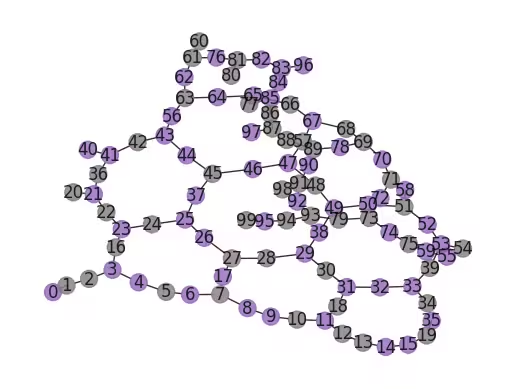
Terakhir, mari kita gambar graf berdasarkan hasil CVaR. Kita bagi simpul-simpul graf menjadi dua himpunan berdasarkan hasil CVaR. Simpul pada himpunan pertama diwarnai abu-abu, dan simpul pada himpunan kedua diwarnai ungu. Sisi-sisi antara kedua himpunan adalah sisi-sisi yang dipotong oleh partisi tersebut.
def plot_result(G, x):
    colors = ["tab:grey" if i == 0 else "tab:purple" for i in x]
    pos, _default_axes = rx.spring_layout(G), plt.axes(frameon=True)
    rx.visualization.mpl_draw(
        G,
        node_color=colors,
        node_size=150,
        alpha=0.8,
        pos=pos,
        with_labels=True,
        width=1,
    )

plot_result(graph_100, to_bitstring(sorted_result_dict[0][0], 100)[::-1])
Referensi
[1] Weidenfeller, J., Valor, L. C., Gacon, J., Tornow, C., Bello, L., Woerner, S., & Egger, D. J. (2022). Scaling of the quantum approximate optimization algorithm on superconducting qubit based hardware. Quantum, 6, 870.
[2] Matsuo, A., Yamashita, S., & Egger, D. J. (2023). A SAT approach to the initial mapping problem in SWAP gate insertion for commuting gates. IEICE Transactions on Fundamentals of Electronics, Communications and Computer Sciences, 106(11), 1424-1431.
[3] Barkoutsos, P. K., Nannicini, G., Robert, A., Tavernelli, I., & Woerner, S. (2020). Improving variational quantum optimization using CVaR. Quantum, 4, 256.
[4] Barron, S. V., Egger, D. J., Pelofske, E., Bärtschi, A., Eidenbenz, S., Lehmkuehler, M., & Woerner, S. (2023). Provable bounds for noise-free expectation values computed from noisy samples. arXiv preprint arXiv:2312.00733.
Langkah berikutnya
Jika kamu merasa karya ini menarik, kamu mungkin tertarik dengan materi berikut:
-
The intractable decathlon: daftar 10 masalah optimasi yang sulit untuk algoritma optimasi klasik, dan yang mungkin menjadi kasus penggunaan yang baik untuk menguji teknik-teknik yang diperkenalkan dalam tutorial ini.
-
Repo praktik terbaik untuk optimasi kuantum untuk lebih meningkatkan hasil alur kerja berbasis QAOA-mu.